
You don’t have a math problem — you know takeout costs money. You have an autopilot problem: dozens of small purchases that happen without a single conscious decision, adding up to hundreds a month you can’t account for. This guide covers the no-spend challenge properly: the rules that make it work, the versions that fit real lives, what to do with the cravings, and how to keep the reset from evaporating on day 31.


A no-spend challenge is a set period — usually a week or a month — during which you stop all non-essential spending. Essentials continue as normal: rent, groceries, bills, transport, medicine. Everything optional pauses: takeout, impulse shopping, subscriptions you can freeze, entertainment purchases. The goal isn’t just the saved money; it’s surfacing your spending triggers by interrupting the autopilot long enough to see it.
Key Takeaways
- A no-spend challenge pauses all non-essential spending for a defined period — most commonly 30 days — while essentials continue normally.
- The real product isn’t the saved cash (typically $150–600 for a month); it’s the trigger map — discovering when and why you reach for your wallet.
- Success depends on written rules made before day one: your essentials list, your exceptions, and your responses to invitations.
- Cravings follow a predictable arc — days 3–10 are the hardest — and each craving survived is data about what the spending was actually doing for you.
- Scaled versions (no-spend weekends, single-category freezes) work better than a 30-day cliff for first-timers and busy seasons.
- The exit plan matters more than the challenge: without a day-31 protocol, most people rebound-spend back to baseline within two weeks.
What a No-Spend Challenge Really Is (And What It’s Actually For)
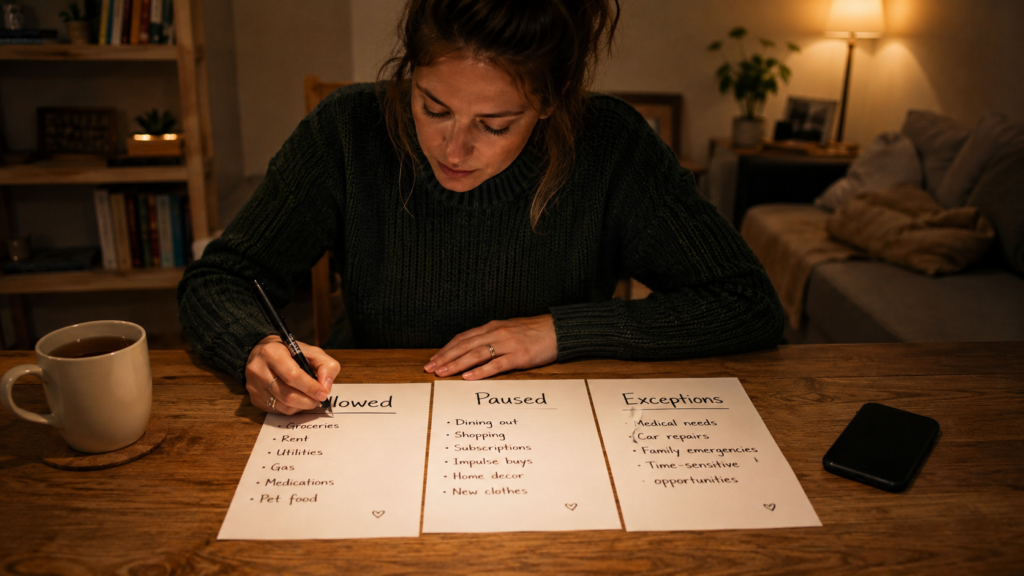
A no-spend challenge is a deliberate spending fast: for a defined window, you buy only what keeps life running and pause everything discretionary. The rules are personal but the skeleton is universal. Always allowed: housing, utilities, groceries for home cooking, transport to work, medications, insurance, debt payments, existing essential subscriptions (your phone plan, not your fourth streaming service). Paused: restaurants and takeout, clothes and gadgets, entertainment purchases, hobby supplies, impulse buys of every species, and any subscription you can freeze without penalty. Gray zone — decided by you in advance: gifts for events that fall inside the window, planned social occasions, replacement of things that genuinely break.
Understand what the challenge is for, because the money is the smaller half. Yes, a typical month saves real cash — most people who track it report $150–600 depending on income and habits, and that lump sum makes a satisfying debt payment or emergency fund deposit. But the durable value is diagnostic. Modern spending is largely automatic: researchers who study consumer behavior consistently find that a large share of purchases are unplanned, cue-triggered responses — boredom at 9 p.m. meets a phone with a shopping app; stress after a bad meeting meets the coffee shop on the walk back. You don’t decide these purchases in any meaningful sense; they happen to you, dozens of times a month, and the receipts blur together into the mystery of where the money went.
The challenge works by interruption. When buying stops being an option, every impulse that would have become a purchase becomes visible instead — a small flash of “I want to order food / buy that / grab a coffee” that you now watch pass without acting. Thirty days of watching builds a map no budgeting app can generate: your specific triggers (boredom? stress? social media? celebration? the 4 p.m. slump?), your specific cues (which apps, which routes home, which moods), and the honest answer to what each spending habit was actually providing. Some purchases turn out to be genuine pleasures worth keeping. Many turn out to be anesthetic — and you can’t renegotiate a habit you’ve never seen clearly.


One framing matters before you start: this is an experiment, not a punishment. The tone you take into the month predicts the outcome. Approached as penance for being “bad with money,” the challenge breeds white-knuckle resentment and a day-31 binge. Approached as a curious 30-day study of your own behavior — with findings you’ll actually use — it becomes genuinely interesting, and the interest is what carries you through week two.
Design Your Challenge: Rules, Length, and the Version That Fits Your Life
A no-spend challenge succeeds or fails at the design stage, before a single dollar goes unspent — and the design has three decisions.
Decision one: length and intensity. The 30-day version is the classic for a reason: long enough to survive novelty, meet a full pay cycle, and expose weekly patterns (weekend spending looks different from Tuesday spending). But it’s not the only door in:
| Version | What it is | Best for |
|---|---|---|
| No-spend month | 30 days, all discretionary spending paused | The full reset; maximum data and savings |
| No-spend week | 7 days, same rules | First-timers; a taster that builds confidence |
| No-spend weekends | Every Sat–Sun for a month | People whose leaks are social/weekend-shaped |
| Category freeze | 30–90 days off one category (clothes, takeout, beauty) | Deep single-habit resets; easier socially |
| No-spend January / seasonal | Annual reset month after holiday spending | Recurring maintenance once you’ve done one |
First-timers do best with a week or a weekend series; finishing a small challenge beats abandoning a grand one, and the habit-forming principle from every discipline domain applies here too — small and completed compounds, big and broken doesn’t.
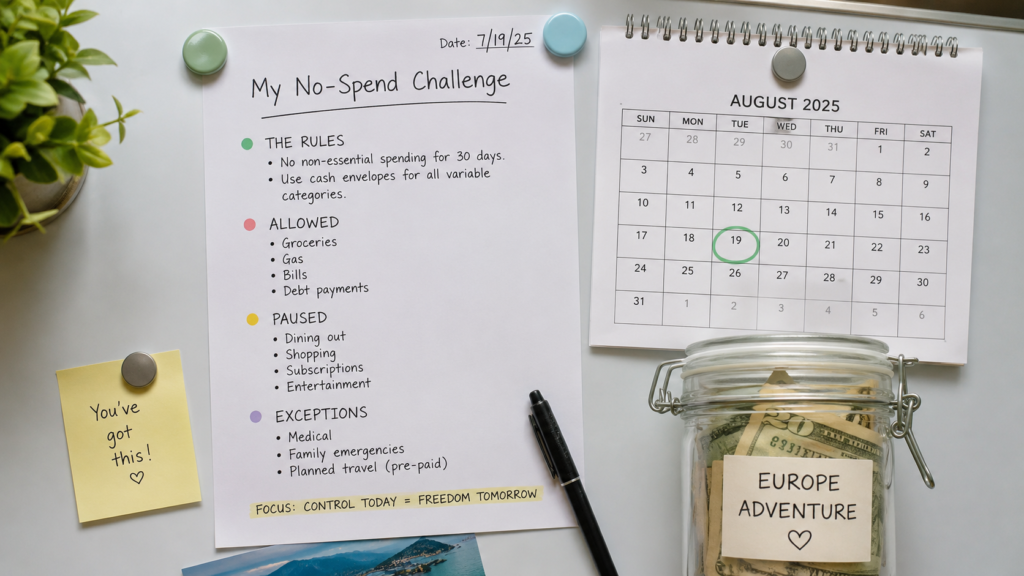
Decision two: your written rules, made before day one. The challenge dies in ambiguity, so eliminate it in advance with three lists. The essentials list (what stays), the paused list (what stops), and — most important — the exceptions list: known events inside the window that you’re pre-approving, in writing. A wedding gift, a planned family dinner, your kid’s field trip fee. Pre-approved exceptions aren’t cheating; they’re the difference between a rule you designed and a rule that ambushes you. What kills challenges is the improvised exception — the day-9 “this doesn’t really count” — because one improvisation licenses the next. Write the rules on paper, date them, and put them on the fridge; a rule you can point to survives moments a rule in your head won’t.
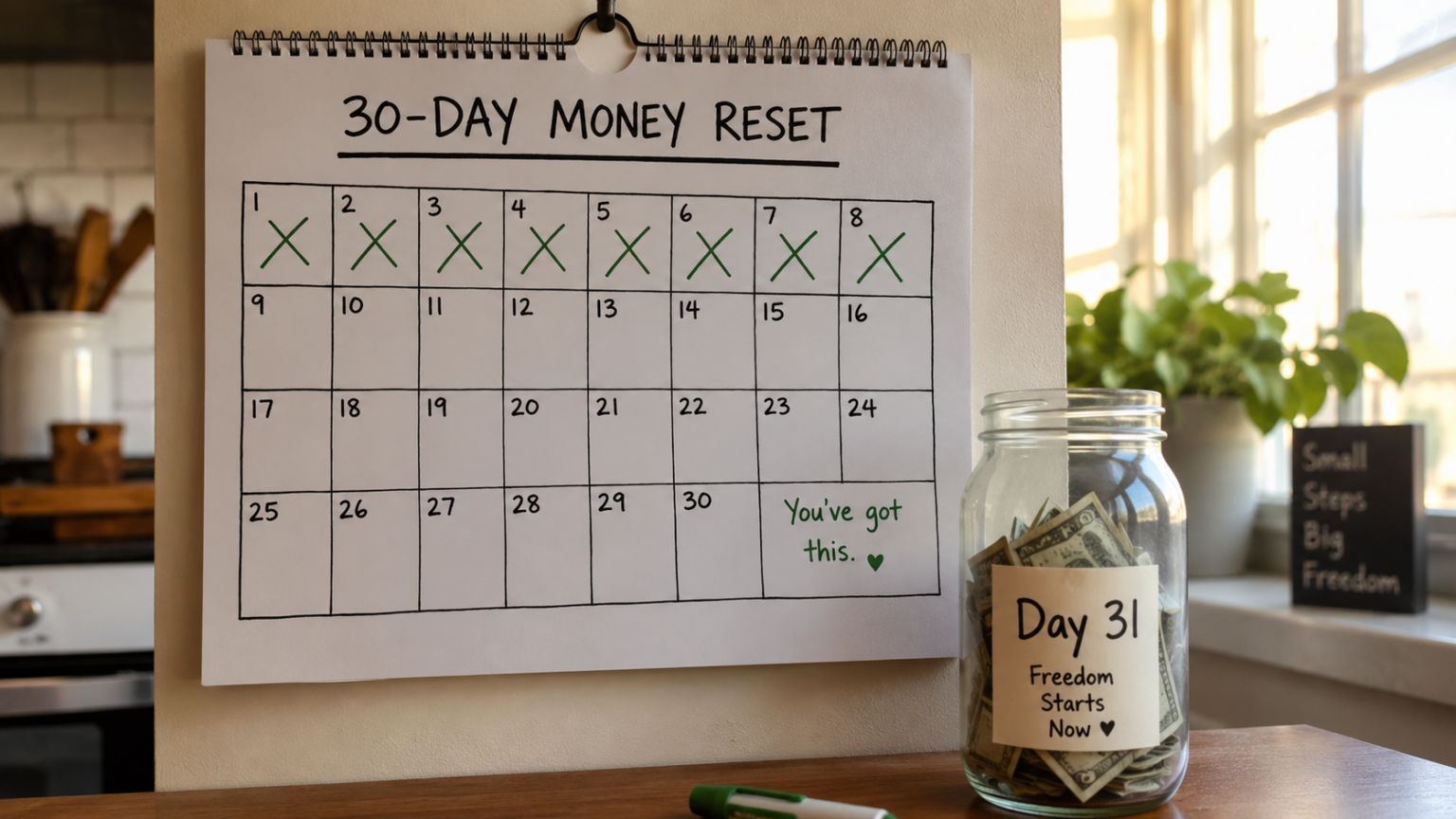
Decision three: the destination for the savings. Decide now where the unspent money goes: a specific debt payment, a named sinking fund, the emergency fund. Then make it real weekly — every few days, transfer what you’d normally have spent into that destination, so the challenge produces a visible, growing number instead of an abstract absence. Watching $340 accumulate in a fund labeled “summer trip” does more for week-three morale than any willpower. This one mechanic — the concurrent visible transfer — separates challenges that feel like deprivation from challenges that feel like progress.
Two setup extras that pay for themselves: tell your people — one sentence to friends and family (“I’m doing a no-spend month, so I’ll suggest the park instead of the café”) converts your social circle from accidental saboteurs into accountability, and most people respond with curiosity rather than judgment. And stock the substitutions in advance: groceries for the meals you’d have ordered, the library card renewed, the free-entertainment list written (more on this next), because day-6 willpower shouldn’t have to invent alternatives from scratch.
Surviving the Middle: Cravings, Social Life, and the Free-Alternatives Playbook

Days three through ten are where no-spend challenges die, because that’s when the novelty fades and the autopilot fights back — so this section is the survival kit.
Expect the craving arc and treat it as data. The urge to spend follows a predictable curve: strong and frequent in week one (your cues are all still firing), peaking somewhere in days 3–10, then genuinely fading as the cues stop paying off. Each individual craving also has a shape — it spikes, plateaus, and passes within roughly 10–20 minutes whether or not you act on it. Two tools flatten the curve. First, the 24-hour list: anything you want to buy goes on a written “maybe later” list with the date. You’re not saying no forever; you’re saying “in 24 hours” — and the list quietly becomes one of the challenge’s best documents, because by day 30 you’ll look at it and discover you no longer want two-thirds of what felt urgent. Second, name the trigger in the moment: when the urge hits, finish the sentence “I want to buy something because I feel ___.” Bored, stressed, tired, left out, celebratory. Affect-labeling research shows naming an emotion reduces its grip — and thirty days of naming builds the trigger map that is the challenge’s real product.
Handle social life with scripts, not avoidance. The genuine hard part of a no-spend month isn’t skipping gadgets; it’s the third dinner invitation. Hiding for a month isn’t the answer — isolation makes the challenge miserable and teaches nothing about sustainable habits. Instead, prepare three moves: redirect (“I’m doing a no-spend month — walk in the park instead? I’ll bring coffee from home”), host (having people over costs groceries, which are already budgeted), and the pre-approved exception (if your sister’s birthday dinner falls mid-month, it was on the exceptions list from day one — go, enjoy it fully, and spend nothing improvised around it). What you’ll likely discover, and what many challenge-finishers report as the month’s biggest surprise: most of your social life was never actually about the spending, and the friends worth keeping are entirely happy with the free version.
Run the free-alternatives playbook. The spending you paused was doing jobs — entertainment, comfort, novelty, connection — and those jobs still need doing. Fill them deliberately: the library (books, films, often free event calendars), every park and trail within reach, the cooking project you’ve postponed (restaurant cravings drop sharply when home food gets interesting), the shelf of unread books and unplayed games you already own — most households sit on months of already-purchased entertainment — free community events, and the friend-visits that cafés were mediating. The deeper discovery here is the one worth writing down: a surprising amount of spending was a convenience tax on not planning ahead. The $14 lunch existed because no lunch was packed; the impulse purchase existed because boredom arrived without a plan. The challenge doesn’t just pause spending — it forces the planning muscle that makes lower spending sustainable afterward.
And when you slip — because many people do once — apply the recovery rule that governs every habit system: one slip is a data point, not a verdict. Write down what happened and what triggered it, put the item’s cost into your savings transfer as if unspent, and continue the challenge the same hour. The self-forgiveness research from procrastination studies applies identically here: punishing the slip loads the challenge with shame, and shame is spending fuel. A 30-day challenge with one honest slip and a finish beats a perfect 9-day challenge abandoned in guilt.
Day 31 and Beyond: The Exit Plan That Makes the Reset Stick

The no-spend challenge has a dirty secret: without an exit plan, most of its gains evaporate in a fortnight of rebound spending — so the final week’s job is designing day 31 before it arrives. Research on restriction in other domains (dieting is the classic) shows the pattern clearly: hard restriction followed by unstructured freedom produces compensatory bingeing, and spending behaves the same way. The fix isn’t extending the challenge forever; it’s a structured re-entry with four components.
Component one: the findings review — one hour, day 30 or 31. Sit down with your three documents: the trigger notes, the 24-hour “maybe later” list, and the savings total. Answer four questions in writing. Which paused purchases did I genuinely miss? (These are real pleasures — they return to the budget, guilt-free and planned.) Which did I stop noticing by week three? (These were pure autopilot — they don’t come back.) What were my top three triggers? (These get environmental fixes: app deleted, route changed, 9 p.m. alternative planned.) What did the money total teach me? Most people find their month splits roughly into thirds — a third of paused spending was worth keeping, a third was habit, and a third was convenience tax — and that ratio, your ratio, is the challenge’s takeaway.
Component two: the deliberate re-entry list. Don’t resume spending; re-admit spending, item by item. Week one after the challenge, restore only the missed purchases from your review — with amounts attached (“dining out returns at $120/month,” not “dining out returns”). This is the moment to install the systems that hold the gains: the returning categories go into cash envelopes or a zero-based budget line, so the autopilot doesn’t quietly rebuild. The challenge cleared the ground; the budget is what you plant.
Component three: keep one permanent rule. Nearly every challenge-finisher reports one restriction that felt so obviously good it shouldn’t end — no purchases before noon, the 24-hour rule on anything over $50, one no-spend day per week, the deleted shopping app staying deleted. Keep exactly one. A single permanent rule carried out of each challenge, compounded across an annual reset, quietly rebuilds your entire spending architecture within a couple of years.
Component four: schedule the next one. The no-spend challenge works best as maintenance, not as a one-time detox — an annual no-spend January after the holidays, or a quarterly no-spend week, keeps the autopilot from silently reassembling. Put the next one on the calendar during the glow of finishing this one, when the benefits are vivid; the concept has entered mainstream personal finance precisely because repeaters keep finding it worth repeating. And give the saved money its moment: transfer the final total to its destination in one ceremonial payment, screenshot it, and let the number argue for the next round.
Common No-Spend Challenge Mistakes (That Even Determined Savers Make)

These are the traps that catch people who genuinely commit — the design flaws rather than the willpower failures.
1. Starting with fuzzy rules and improvising the gray zone. “No unnecessary spending” sounds clear until day 5 asks whether a pharmacy run, a coworker’s farewell gift, and replacing broken headphones count. Each improvised ruling weakens the next boundary. Fix: write the three lists (essentials, paused, pre-approved exceptions) before day one, on paper, dated. When a genuinely novel case appears mid-challenge, apply the strictest plausible reading today and add a written rule for next time — rule-making happens between challenges, not during cravings.
2. Stockpiling before the start. The pre-challenge “supply run” — pantry loaded, wishlist cleared, wardrobe topped up “so I won’t need anything” — simply relocates the month’s spending to day zero and hollows out the experiment. The savings figure lies, and worse, the trigger data never appears because the wants were pre-satisfied. Fix: normal grocery shopping the week before, nothing else. Facing wants unstocked is the challenge; that’s where the information lives.
3. Running the challenge during the wrong month. Launching a no-spend month across your birthday, a wedding weekend, a house move, and the holidays guarantees either constant pre-approved exceptions (diluting the reset) or constant misery (guaranteeing a rebound). Fix: pick a boring month — the calendar’s flattest 30 days — for the full challenge, and cover the eventful seasons with lighter versions like no-spend weekdays. The challenge should fight your autopilot, not your entire life.
4. Measuring only the money. Tracking just the dollars saved makes week three feel pointless the moment the number plateaus — and misses the challenge’s larger product entirely. Fix: keep the trigger journal as seriously as the savings tally. Three lines a day (“wanted takeout at 9pm — trigger: boredom + phone”). On day 30 the journal, not the total, is what changes next year’s spending; people who keep it report the insights outlasting the cash by years.
5. Ending with a celebration purchase. The day-31 “I earned this” splurge — often costing a meaningful chunk of the month’s savings — teaches your brain that restriction is a token system redeemable for stuff, which reactivates the exact loop you spent 30 days quieting. Fix: celebrate with the transfer ceremony instead — move the full total to its destination, screenshot the number, and mark the finish with something from the free-alternatives list. If a genuine want survived the whole month on your 24-hour list, buy it the following week as a planned budget item, not as a finish-line reward.
FAQ

What are the rules of a no-spend challenge?
You set them in advance, but the standard skeleton: essentials continue (rent, bills, groceries, transport, medicine, debt payments), and everything discretionary pauses (takeout, shopping, entertainment purchases, impulse buys, freezable subscriptions). The key is writing three lists before day one — allowed, paused, and pre-approved exceptions for known events — so day-9 cravings never get to improvise the rules.
How much money can you save with a no-spend month?
Most people who track it report $150–600 for a 30-day challenge, depending on income and how leaky their discretionary spending was. But the durable value is the diagnosis: a month of interrupted autopilot maps your spending triggers — when, where, and why you buy — and that map keeps saving money for years after the lump sum is spent.
What can you buy during a no-spend challenge?
Everything that keeps life running: housing, utilities, groceries for home cooking, commuting costs, medications, insurance, and existing debt payments. Pre-approved exceptions you wrote down before starting — a wedding gift, a planned family event — also count as legal. The test for gray areas: would skipping this cause real harm, or just discomfort? Harm buys; discomfort waits.
How do I do a no-spend challenge with a family?
Get buy-in before day one, not compliance after: one family meeting, shared rules, and kids assigned the fun part (finding free activities, cooking projects). Keep essentials generous — a no-spend month should never touch children’s genuine needs — and pre-approve family events. Many families find the free-alternatives hunt becomes the month’s highlight; frame it as a game with a visible savings jar, not a punishment.
What do I do when I really want to buy something during the challenge?
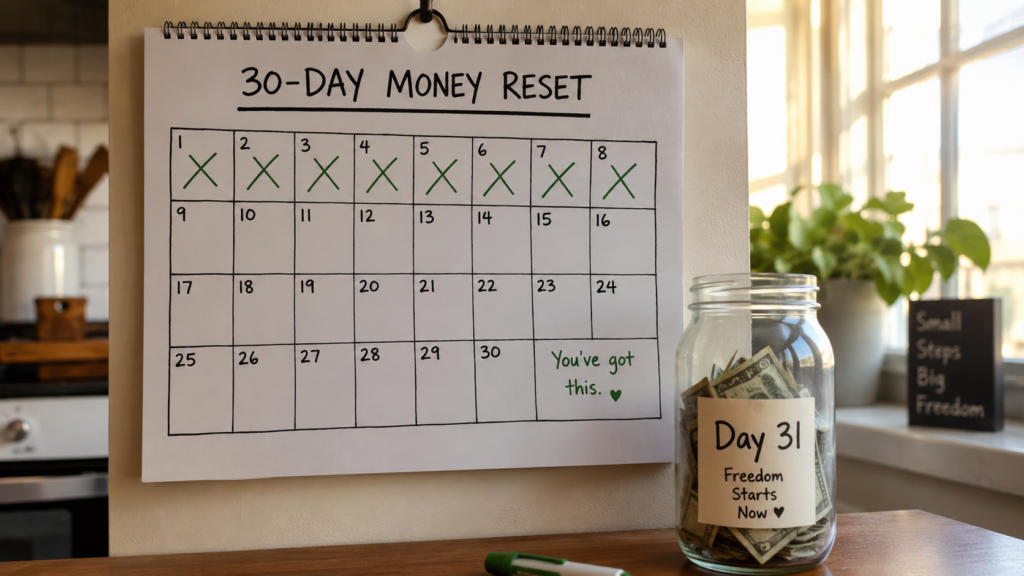
Put it on a written 24-hour list with the date — you’re not refusing forever, just delaying — and name the feeling driving the urge (“bored,” “stressed,” “celebrating”). Cravings pass in 10–20 minutes, and by day 30 most items on your list will have stopped mattering. The ones that still matter were real wants; buy them after the challenge as planned purchases.
What happens after the no-spend challenge ends?
The exit plan decides everything: review your trigger notes and wish list, re-admit only the spending you genuinely missed (with monthly amounts attached), route those categories into a budget or cash envelopes, keep one permanent rule from the month, and schedule the next challenge. Without this structure, rebound spending typically erases the gains within two weeks.
The Bottom Line
A no-spend challenge is thirty days of interrupting the autopilot long enough to see it — and what you see is worth more than what you save: your triggers, your convenience taxes, and the third of your spending that was never really a decision. Design the rules before day one, survive the middle with lists and scripts, and exit with a plan instead of a splurge. Pick your flattest upcoming month tonight, write the three lists — and let day one be the first day you watch a craving pass instead of paying it.