


Every January you design the perfect morning: 5 a.m. wake-up, workout, journaling, reading, meditation. By February it’s rubble, and by March you’ve concluded you’re “not a morning person.” The routine wasn’t too hard for you — it was built wrong. This guide shows you how to build a morning routine sized to your real life, anchored to habits that survive bad sleep, sick kids, and Mondays.
A morning routine that lasts is short, specific, and anchored — not long and aspirational. Build it in three steps: pick one anchor habit that starts automatically after an existing cue (like drinking water right after your alarm), keep the full routine under 30 minutes for the first two months, and design a five-minute “bad day” version you can run on your worst mornings. Consistency on a small routine beats perfection on a grand one.

Key Takeaways
- Routines fail from overbuilding, not weak willpower — start under 30 minutes and expand only after eight consistent weeks.
- Anchor each habit to an existing cue (“after I pour coffee, I write three priorities”) — habit research shows cue-attached behaviors become automatic where floating intentions don’t.
- Your morning is decided the night before: a consistent bedtime and a 10-minute evening setup do more than any 5 a.m. alarm.
- Build two versions from day one — the full routine and a 5-minute minimum — so bad mornings bend the routine instead of breaking the streak.
- The 5 a.m. club is optional; the science supports consistent wake times matched to your chronotype, not universal early rising.
- Missing one day is noise; missing two starts a pattern — the “never miss twice” rule is the maintenance policy.
Why Morning Routines Collapse by February (It’s Not Your Discipline)
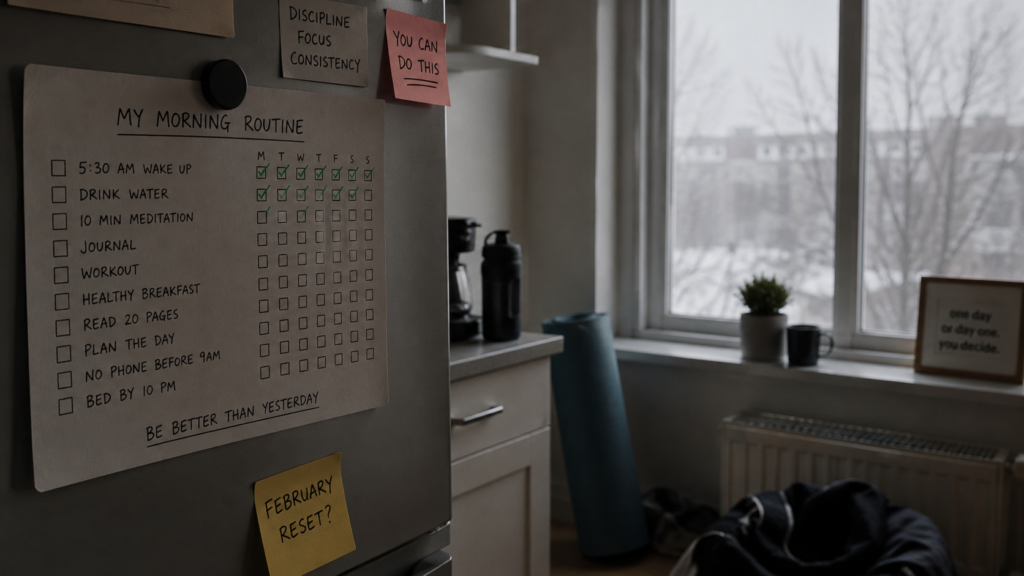
Morning routines die from design flaws, not character flaws — and the same three flaws appear in almost every abandoned routine. Understanding them is most of the cure.


Flaw one: the routine was built for your best self on your best day. The January version assumes eight hours of sleep, no sick kids, no late nights, and infinite morning enthusiasm.
Real life delivers maybe two such mornings a week. A 90-minute routine that requires ideal conditions doesn’t have a 90-minute problem — it has a conditions problem: most mornings simply don’t qualify, so most mornings register as failure, and humans quit things that make them feel like failures.
Behavioral scientists studying habit formation, including the well-known University College London work by Phillippa Lally, found new habits take on average about 66 days to become automatic — and, crucially, that the habits which survived were the smaller ones. Complexity is a tax paid daily; simple behaviors compound.


Flaw two: the routine had no floor. Every routine meets a terrible morning eventually — the 2 a.m. baby, the red-eye flight, the flu. If the routine’s only mode is “complete,” a terrible morning scores zero, the streak dies, and streak-death is demoralizing out of all proportion to one missed day. Routines with a designed minimum — a five-minute version that still “counts” — survive these mornings intact. Routines without one shatter.
Flaw three: it copied someone else’s morning. The CEO’s 4:30 a.m. cold plunge went viral, so you adopted it — ignoring that he sleeps at 8:30 p.m., has a driver, and doesn’t do daycare drop-off. Chronobiology is blunt on this: humans have genetically influenced chronotypes (your body’s natural timing preference), and roughly as many people lean late as lean early. Sleep researcher Matthew Walker, author of Why We Sleep, has repeatedly argued that forcing night-owl chronotypes into extreme early schedules mostly manufactures sleep deprivation — and sleep deprivation destroys precisely the mood, focus, and self-control the routine was supposed to build. The Sleep Foundation’s chronotype overview is a solid primer.


Read those three flaws together and the redesign writes itself: build small, build a floor, and build for your biology and logistics. The next section does exactly that.
The 3-Step Build: Anchor Habit, 30-Minute Cap, and the Bad-Day Version

Building a routine that survives to March takes three deliberate design decisions, made once. Here’s each, with the reasoning.
Step 1: Choose one anchor habit and weld it to an existing cue. An anchor habit is the routine’s first domino — small, unmissable, and attached to something you already do automatically.
The formula, drawn from BJ Fogg’s behavior research at Stanford (he calls it “anchoring” in Tiny Habits): after [existing behavior], I will [new tiny behavior]. After my feet touch the floor, I drink the glass of water on the nightstand. After I start the coffee, I write today’s top three tasks. The existing behavior fires automatically; the new one rides its coattails.
Research on implementation intentions — Peter Gollwitzer’s work spanning decades — shows this cue-attached format dramatically outperforms vague resolutions like “I’ll journal in the mornings,” because the trigger does the remembering for you. Pick one anchor. Not four. The rest of the routine will eventually chain off it.
Step 2: Cap the whole routine at 30 minutes for two months. List what you actually want mornings to give you — usually some mix of movement, quiet, planning, and not-being-rushed — then fit modest versions inside half an hour: ten minutes of stretching, five of journaling, ten of coffee with your priorities list, five of buffer. It will feel too easy. That’s correct: the first eight weeks aren’t for results, they’re for making the routine automatic, and automaticity loves easy. After eight consistent weeks, expand one element at a time — ten minutes of stretching becomes a 25-minute workout — on a foundation that’s already load-bearing.
Step 3: Design the bad-day version before you need it. Decide now what the five-minute minimum looks like: water, three deep breaths, write the day’s single priority. Done. On the awful mornings — and they’re coming — you run the minimum and the routine survives. This isn’t lowering the bar; it’s building a second, lower bar so the streak never has to hit zero. Athletes call this training through injury with modified workouts; the alternative, stopping entirely, is how fitness and routines both unravel.
Two supporting decisions round out the build. Prepare the night before: clothes out, coffee prepped, phone charging outside the bedroom, tomorrow’s top task written down. A ten-minute evening setup removes the friction and decisions that ambush groggy morning brains — and a consistent bedtime is, unglamorously, the single highest-leverage morning habit in existence. Protect the first phone-free window: even fifteen minutes. The moment you open messages or feeds, your attention belongs to other people’s priorities; a routine’s entire purpose is to spend the morning’s first energy on yours.
What to Put in Your Morning Routine: The Menu, Not the Mandate

There is no scientifically required morning checklist — there’s a menu of components with real evidence behind them, from which you pick two or three that match your actual goals. Here’s the menu with honest notes.
| Component | Time | What the evidence supports | Skip if |
|---|---|---|---|
| Hydration | 1 min | You wake mildly dehydrated after 7–8 hours; water helps alertness. Cheap, instant, ideal anchor habit. | Almost never — it’s free |
| Daylight exposure | 5–10 min | Morning light anchors your circadian clock, improving night sleep and daytime alertness; strongly supported by sleep science. | You wake before dawn — use bright indoor light |
| Movement | 5–30 min | Any movement raises alertness and mood; morning exercisers show better adherence (fewer schedule conflicts), not magic extra gains. | Evening workouts genuinely fit your life better |
| Planning / priorities | 5 min | Writing the day’s top 1–3 tasks before inputs arrive protects deep work; pairs perfectly with time blocking. | Rarely — highest ROI per minute on the menu |
| Journaling / gratitude | 5–10 min | Gratitude and expressive writing show measurable mood benefits in studies (e.g., Emmons & McCullough’s gratitude research). | It feels like homework — mood benefits require buy-in |
| Meditation / breathwork | 5–15 min | Consistent practice shows attention and stress benefits; five minutes counts. | Forcing it breeds resentment — try a walk instead |
| Reading | 10–20 min | No special morning magic, but mornings are when the time reliably exists. | Your mornings are already tight |
| Cold showers | 2–3 min | Real but modest alertness spike; most grand claims outrun the data. | You hate it — suffering isn’t a productivity nutrient |
Three notes on using the menu. First, match components to a goal, not to an identity. “I want to stop starting workdays reactive” points to planning plus a phone-free window. “I want to stop feeling exhausted” points to daylight, bedtime, and possibly removing things from your morning. A routine assembled around a real problem sticks; one assembled to feel like a person who has routines doesn’t.
Second, sequence for momentum: easiest and most physical first (water, light, movement), attention-demanding second (planning, journaling), pleasant last (coffee and reading as the finish line reward).
Third, coffee timing is a genuine trick worth stealing — caffeine researchers note that delaying coffee 60–90 minutes after waking avoids stacking it on your natural morning cortisol peak and softens the afternoon crash. If that sounds miserable, ignore it; the routine you enjoy beats the optimized one you resent. Harvard Health’s health blog covers most of these components in depth if you want sourcing trails.
Keeping It Alive: Never Miss Twice, Seasonal Rebuilds, and the March Test
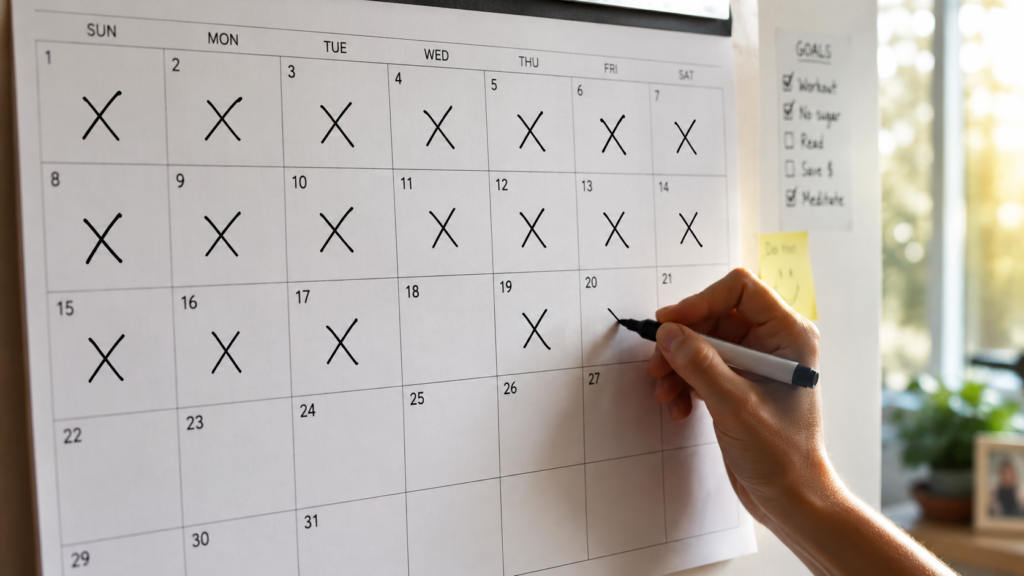
A routine’s first month runs on novelty; months two through twelve run on maintenance policy, and this is the policy.
Adopt “never miss twice” as the only rule that matters. Missing one morning is statistically inevitable and psychologically trivial — Lally’s habit research found single missed days had essentially no effect on long-term habit formation. The danger is the second consecutive miss, because two misses is the beginning of a new pattern: not-doing-the-routine. So the rule isn’t “never miss”; it’s the morning after a miss is the most important morning of the month, and on that morning the bad-day version absolutely counts. This single reframe removes the all-or-nothing psychology that kills more routines than laziness ever has.
Track presence, not performance. A simple calendar X for “ran the routine (either version)” beats elaborate scoring. What you’re building is the identity of someone who shows up, and the chain of X’s is that identity made visible. Jerry Seinfeld’s famous “don’t break the chain” method is this exact mechanism, and it works precisely because the bar is binary and low.
Expect and pre-plan the three routine-killers. Travel: decide in advance that the hotel version is water, light, and priorities — five minutes, still counts. Illness: the routine is officially suspended, guilt-free, resuming with the bad-day version on your first okay morning. Schedule earthquakes (new job, new baby, new semester): don’t patch the old routine — rebuild from scratch with the 3-step method, because a routine designed for a life you no longer live will fail no matter how loyal you feel to it. Seasonal rebuilds every few months are a feature of long-term routine keepers, not a sign of inconsistency.
Run the March test. Once a quarter, ask three questions of every component: Do I still do this most mornings? Does it still serve a current goal? Would I add it today if it weren’t already here? Anything failing two of three gets cut without ceremony. Routines accumulate barnacles — the journaling that became rote, the meditation you now resent — and pruning them keeps the routine light enough to survive. The routines still alive in March are almost never the most ambitious ones from January; they’re the ones that got smaller, honest, and personal.
Common Morning Routine Mistakes (That Even Motivated People Make)

Past the obvious “don’t snooze,” these are the traps that catch people genuinely committed to the project.
1. Changing wake time and routine content simultaneously. Moving from 7:30 to 5:30 while also adding a workout, journaling, and reading stacks two hard changes — and the sleep-deprived brain from change one sabotages the willpower change two requires. Fix: keep your current wake time and build the routine first. If earlier waking still matters after eight weeks, shift in 15-minute weekly increments, moving bedtime first. Wake time is downstream of bedtime; ignoring that is the number one source of February collapse.
2. Front-loading the routine with the hardest habit. Leading with the 40-minute workout means the whole routine dies on any morning the workout feels impossible — the hardest domino is holding up all the others. Fix: lead with the easiest habits (water, light, coffee ritual) so the routine starts automatically every single day, and place harder elements mid-chain where momentum carries you into them.
3. Measuring the routine by how the morning feels. Some mornings the journaling is profound and the stretch feels great; many mornings everything is mechanical and flat, and people read the flatness as “it’s not working.” Fix: judge the routine on 30-day outcomes — sleep quality, how often you start work reactive, baseline mood — not on daily sensations. Habit payoffs compound quietly; the flat mornings are the ones building the automaticity.
4. Letting the routine become a second job. The 30-minute routine grows to 45, then 70, each addition individually reasonable — until the routine itself becomes the reason mornings feel rushed and you’re waking early to serve your own checklist. Fix: hard cap the routine’s length and enforce one-in-one-out: adding breathwork means something else shrinks. The quarterly March test exists to catch this bloat.
5. Hiding the phone problem instead of solving it. “I’ll just check quickly” is the most-broken promise in modern mornings — one glance at messages converts your protected window into reactive time, routine technically intact but purpose gone. Fix: make the phone structurally unavailable, not willpower-unavailable: charge it outside the bedroom, use a $10 alarm clock, and let the phone’s first appearance be a scheduled part of the routine’s end, not an ambient temptation throughout.
FAQ

What should a morning routine include? Whatever serves your actual goal — there’s no mandatory checklist. The highest-value components for most people: a glass of water, a few minutes of daylight, five minutes writing the day’s top priorities, and a phone-free first window. Add movement, journaling, or reading based on what problem you’re solving. Two or three components under 30 minutes beats a seven-part production.
How long should a morning routine be? Under 30 minutes for your first two months — the early phase is about making it automatic, and small routines become automatic while grand ones collapse. After eight consistent weeks, expand one element at a time if you want to. Also build a five-minute minimum version for bad mornings, so rough days bend the routine instead of breaking it.
Do I have to wake up at 5 a.m. for a good morning routine? No. The science supports a consistent wake time matched to your chronotype — your body’s natural timing preference — not universal early rising. Night-owl types who force 5 a.m. mostly manufacture sleep deprivation, which destroys the focus and mood the routine was meant to build. A solid routine at 7:45 beats an exhausted one at 5:00.
How long does it take for a morning routine to become a habit? Research on habit formation — notably Phillippa Lally’s University College London study — found automaticity takes about 66 days on average, ranging from three weeks to several months depending on the habit’s complexity. Simpler routines lock in faster, which is another argument for starting small. Missing a single day, the same research found, barely affects the process.
What’s the first thing I should do in the morning? Something tiny, physical, and attached to a cue you can’t miss — drinking a glass of water the moment your feet touch the floor is the classic anchor habit. It requires zero willpower, starts the routine automatically, and the rest of your habits chain off it. Avoid starting with your phone: one glance at messages hands your first energy to other people’s priorities.
How do I get back into a morning routine after falling off? Run the five-minute minimum version tomorrow — water, breathe, write one priority — and count it as a full success. The “never miss twice” rule is the whole recovery protocol: one missed day is noise, two starts a new pattern. Don’t rebuild bigger out of guilt; if life changed since the routine was designed, rebuild smaller to fit the life you have now.
Closing
A morning routine survives to March by being small enough to run automatically, anchored to cues that fire without willpower, and equipped with a five-minute floor for the mornings that go sideways. The version that lasts is never January’s ambitious draft — it’s the honest, trimmed one that fits your sleep, your chronotype, and your actual Tuesday. Tonight, set out a glass of water, write tomorrow’s single top priority, and let that two-minute anchor be day one of the routine you’ll still be running in spring.
Don’t Miss: