

Bullet journal for beginners, You’ve seen the bullet journals on Instagram — watercolor headers, hand-lettered quotes, spreads that take longer to draw than the week they organize. Then you tried one, spent two hours on a habit tracker, and quietly stopped by week three. This guide teaches the bullet journal as it was actually designed: a fast, ugly-on-purpose system you can set up tonight with any notebook and one pen.
A bullet journal is a customizable notebook system that combines your to-do list, planner, and notes in one place using short bulleted entries called “rapid logging.” Created by designer Ryder Carroll, the core setup needs just four parts: an index, a future log for coming months, a monthly log, and daily logs where you jot tasks (•), events (○), and notes (–). No artistic skill required — the original system is deliberately plain.

Key Takeaways
- The bullet journal’s core is rapid logging: short bulleted entries with three symbols — a dot for tasks, a circle for events, a dash for notes.
- The full beginner setup is four spreads (index, future log, monthly log, daily log) and takes about 20 minutes with any notebook and pen.
- Monthly migration — rewriting unfinished tasks by hand — is the system’s secret weapon: the friction forces you to drop tasks that don’t deserve your time.
- The decorated journals you see online are a hobby layered on top of the method; the method itself was designed by Carroll partly to manage his own ADHD, fast and plain.
- Start with dailies and a monthly log only; add collections and trackers one at a time, only after two weeks of consistent use.
- An “ugly” bullet journal that gets opened daily beats a beautiful one abandoned in February.
What a Bullet Journal Actually Is (Hint: Not an Art Project)
A bullet journal is an analog organization method built on one notebook, one pen, and a handful of conventions — and the distance between the original system and its Instagram reputation is enormous. Ryder Carroll, a Brooklyn-based digital product designer, developed the method over years of managing his own attention challenges; he was diagnosed with ADD as a child and needed a capture system faster than his distractibility. He shared it publicly in 2013 at bulletjournal.com, and his book The Bullet Journal Method (2018) became an international bestseller. The official system he teaches is stark: black ink, plain lists, function over form. Carroll has said in interviews that his own journal would disappoint Pinterest.


The method rests on a practice he named rapid logging — capturing information as short bulleted lines the moment it appears, using symbols instead of sentences:
- • Task — something to do (“• call dentist”)
- ○ Event — something happening (“○ Sara’s birthday”)
- – Note — something to remember (“– boss prefers Tuesday check-ins”)
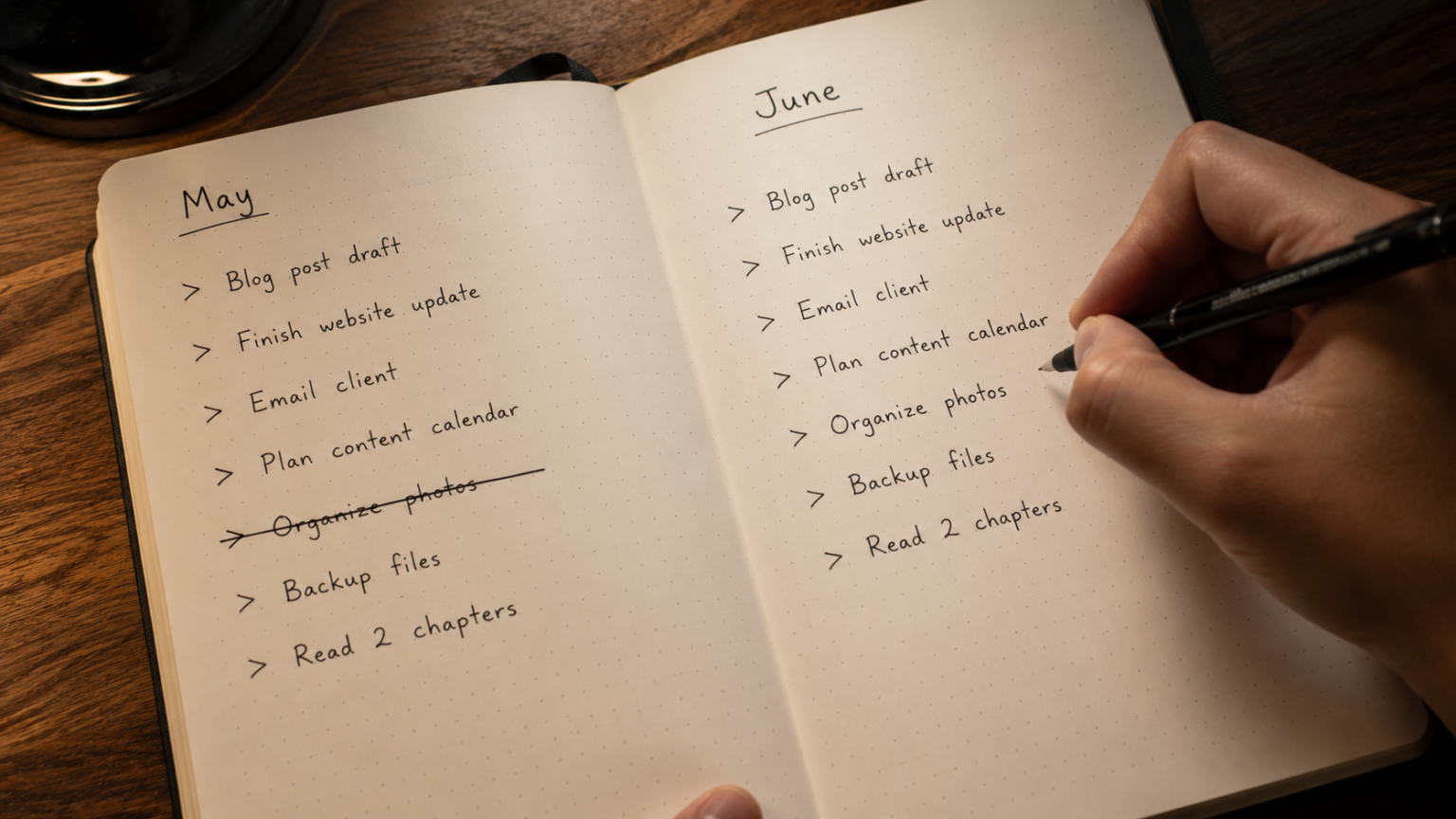
When a task completes, the dot becomes an ×. When it moves to another day, it becomes >. When it’s scheduled into the future log, it becomes <. That’s the entire notation. A day’s entry might be six lines and take ninety seconds — which is precisely the point. The system is designed to be faster than your urge to skip it.

Why analog, when your phone has seventeen apps for this? Two honest reasons. First, writing by hand is slower, and that slowness is a filter — you naturally summarize and prioritize rather than transcribing noise. Research on note-taking, including the widely cited Mueller and Oppenheimer studies comparing longhand and laptop notes, found handwriting’s slowness pushed people to process rather than record, improving conceptual retention. Second, a notebook can’t ping you. Opening it to log a task doesn’t ambush you with a group chat and a headline. In an attention economy, a tool that does nothing except hold your thoughts is a feature, not a limitation.


What the bullet journal is not: a diary (though it can hold one), an art medium (though some make it one), or a rigid planner with pre-printed dates you feel guilty about skipping. Blank pages don’t accuse you. You missed four days? The next entry is just… the next entry.
The 20-Minute Starter Setup: Four Spreads and Nothing Else
Your entire first setup is four spreads, built in this order, in roughly twenty minutes — resist adding anything beyond them tonight. Any notebook works; the classic choice is a dotted A5 (dots guide straight lines without imposing a grid), but a school exercise book genuinely does the job.
Spread 1: The Index (first 2 pages). Title two pages “Index” and leave them blank. As your journal grows, you’ll log where things live: “Monthly Log — p.5”, “Books to Read — p.23”. Number your pages as you go if the notebook isn’t pre-numbered. The index is what makes one chaotic notebook function like an organized system — anything can go anywhere, because everything is findable.
Spread 2: The Future Log (next 4 pages). Divide each page into three sections and label them with the next six months. This is the parking lot for anything dated beyond this month: “○ March — passport renewal”, “○ May — cousin’s wedding”. Without it, future commitments either clog your dailies or evaporate. Thirty seconds to consult when planning a new month.
Spread 3: The Monthly Log (2 pages). Left page: the dates of the month in a vertical column, one line each, for events and deadlines at a glance. Right page: a plain task list — everything you intend to get done this month, unscheduled. That right-hand page is your month’s honest inventory, and you’ll meet it again at migration time.
Spread 4: The Daily Log (starts on the very next page). Write today’s date. Rapid-log beneath it. Tomorrow, write tomorrow’s date directly below wherever today ended — no pre-drawn boxes, no wasted space, no guilt-inducing empty pages for days you skip. The daily log is where the journal actually lives; everything else exists to serve it.
That’s the whole system. The named spreads people add later — habit trackers, gratitude logs, project pages — are called collections, and the standing rule for beginners is: earn them. Use dailies and the monthly log for two full weeks first. Then add one collection you’ve genuinely felt the need for. A journal that accretes features slowly gets used; a journal born with twelve trackers gets abandoned by the fourth week, because you built a maintenance burden before building the habit. Carroll’s own starter guidance at bulletjournal.com/learn teaches exactly this minimal core.
Migration: The Boring-Sounding Habit That Makes the Whole System Work

Migration is the monthly ritual of manually rewriting unfinished tasks into the new month, and it’s the mechanism that separates the bullet journal from every to-do app you’ve abandoned. It sounds like pointless copying. It’s the opposite.
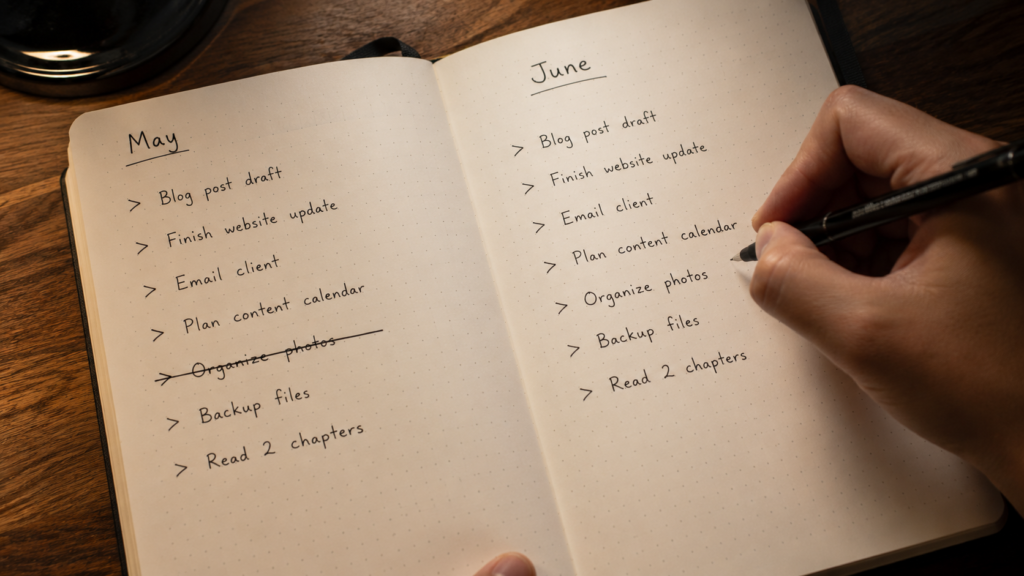
Here’s the ritual. At each month’s end, you set up the next monthly log, then review every open task — the un-crossed dots. For each one, three choices: complete it now if it’s trivial, migrate it (rewrite it in the new month, marking the old entry >), or kill it — strike it out because it’s no longer worth doing.
The genius is in the friction. Digital task apps let a task roll over forever at zero cost; that’s why your app contains items from 2023 that you scroll past with a small pulse of guilt, forty times a week. Handwriting makes carryover cost something. The third time you physically rewrite “• research standing desks,” your hand asks your brain a question no app ever forces: is this actually worth doing, or am I just carrying it? Carroll frames this as the system’s core philosophy — the bullet journal isn’t a productivity tool so much as an intentionality tool. Migration is a recurring appointment with the question “does this deserve my life’s time?”
In practice, expect three outcomes each month. A few tasks migrate and get done — fine. A few migrate repeatedly — these deserve a harder look: they’re usually either projects masquerading as tasks (break “plan the trip” into its first physical action: “• email hotel about April dates”) or obligations you’re avoiding for a reason worth naming. And a satisfying handful get killed — struck through with a ruler-straight line and genuine relief. Killing tasks is not failure. Killing tasks is the system succeeding: it just returned hours of your future to you.
A weekly micro-migration helps too: each Sunday, scan the week’s dailies for open dots and pull the still-relevant ones forward to Monday. Five minutes. It keeps dailies from becoming an archaeology dig and makes the monthly ritual light.
One more quiet benefit: migration produces an honest record of what you chose not to do, which no app surfaces. Six months of killed tasks teaches you more about your actual priorities than any goal-setting exercise — you’ll notice entire categories you keep writing down and keep declining to live. That pattern is information. Some people discover a hobby they should formally quit; others discover a dream they should finally schedule.
Minimalist vs. Decorated: Choosing Your Style (and a Sample Week in Each)
The bullet journal community spans two cultures — functional minimalism and decorative journaling — and choosing yours deliberately, instead of drifting into the wrong one, prevents the most common beginner burnout.
| Minimalist BuJo | Decorated BuJo | |
|---|---|---|
| Daily time cost | 2–5 minutes | 15–60+ minutes |
| Materials | One notebook, one pen | Notebook, fineliners, brush pens, washi, stencils |
| Monthly setup | ~20 minutes | 2–5 hours |
| Its real product | Organization and clarity | Organization plus a creative hobby |
| Fails when | Rarely — too cheap to fail | Time runs short; perfectionism stalls entries |
| Best for | Busy people, ADHD brains, skeptics of “systems” | People who find drawing relaxing and want a ritual |
Neither is wrong, but they answer different questions. Minimalist journaling answers “how do I organize my life?” Decorated journaling answers that plus “where does my creative time go?” — it’s genuinely a craft hobby, closer to sketching than to scheduling, and thousands of people find the drawing itself meditative and mood-lifting. The trouble starts only when someone wants the first thing and accidentally signs up for the second, then interprets the hobby’s time cost as personal failure at organization.
A sample Tuesday, minimalist style — total time about three minutes:
TUE 14.03 • email invoice to Hassan × • gym — legs × ○ team review 15:00 – Layla suggested “Deep Work” — add to book list • book dentist >
The same Tuesday in a decorated journal might sit under a hand-lettered header with a weather doodle and a color-coded mood bar — identical information, plus twenty minutes of craft.
The honest recommendation for beginners: run minimalist for your first sixty days regardless of where you intend to end up. You’ll learn the system’s mechanics without the artistic overhead, and you’ll discover whether the method serves you before deciding whether the hobby does. If the drawing itch is real after two months, add decoration gradually — headers first, full spreads later — and do the setup in one relaxed weekend session rather than nightly. And if you’re on the fence about materials: a $6 notebook you’ll fearlessly scribble in beats a $30 one you’re afraid to “ruin.” Fear of the nice notebook is a real and documented beginner-killer.
Common Bullet Journal Mistakes (That Even Committed Beginners Make)
Beyond “don’t overdecorate,” these are the traps that catch people who’ve read the guides and genuinely committed.
1. Building a museum of trackers in week one. Habit tracker, sleep log, water intake, mood chart, spending log — each one is a daily maintenance payment, and eight of them cost more willpower than the habits they track. By week four the trackers are half-empty, the emptiness reads as failure, and the failure infects the whole journal. Fix: zero trackers for two weeks, then one — the single habit you most want to change. Add another only when the first has survived a full month.
2. Pre-drawing weeks or months ahead. Drawing four weekly spreads in advance feels efficient, but life doesn’t cooperate: a chaotic week leaves a pre-drawn spread half-empty, and that visible emptiness is exactly the guilt trigger the bullet journal was designed to eliminate. Pre-printed planners fail people for this precise reason. Fix: never draw further ahead than the current month’s log. Dailies are created day-of, sized to the day they actually get.
3. Treating a missed week as a broken journal. You stop for nine days — travel, illness, life — and returning feels like it requires an apology page or a fresh notebook. It doesn’t. Fix: write today’s date and rapid-log. That’s the entire re-entry protocol. The gap needs no explanation; blank pages hold no grudges. Journals survive on returns, not on streaks.
4. Writing projects as tasks. “• plan Mom’s birthday party” migrates for three consecutive months because it isn’t a task — it’s eleven tasks wearing a trench coat, and your brain correctly refuses to start something with no defined first action. Fix: when a bullet migrates twice, break it down. The rewrite becomes “• text siblings about party budget” — a five-minute action that actually gets an ×. Repeat offenders may deserve their own collection page.
5. Skipping the index because “I’ll remember where things are.” You won’t. By page 60 the journal holds a monthly log, nine dailies, a books list, and meeting notes from March, and finding anything means flipping. The unfindable journal stops being consulted, and an unconsulted journal dies quietly. Fix: number pages as you use them and log every collection and monthly in the index the moment you create it — a four-second habit that keeps six months of notebook usable.
FAQ
What is a bullet journal in simple terms? It’s one notebook that replaces your planner, to-do list, and notes app, using quick bulleted entries instead of full sentences. A dot means a task, a circle means an event, a dash means a note. You set up an index, a future log, a monthly page, and then just log each day as it comes. Setup takes about twenty minutes with any notebook.
Do I need to be artistic to bullet journal? No — the decorated journals online are an optional hobby layered on top of the method. The original system, created by designer Ryder Carroll partly to manage his own ADHD, is deliberately plain: black pen, straight lists, no drawing. A functional daily entry takes two or three minutes. If you enjoy lettering and doodling, you can add it later; it’s craft, not requirement.
What do I need to start a bullet journal? Any notebook and any pen — genuinely. The popular choice is a dotted A5 notebook because dots make neat lines easy without a heavy grid, but a plain exercise book works identically. Skip the brush pens, stencils, and washi tape entirely for your first two months. A cheap notebook you’ll scribble in fearlessly beats an expensive one you’re scared to ruin.
What’s the difference between a bullet journal and a planner? A planner arrives pre-printed: fixed dates, fixed boxes, and guilt-inducing blanks when you skip days. A bullet journal is built as you go — each day gets exactly the space it needs, a missed week leaves no empty pages, and you can add custom sections (books, projects, trips) anywhere, tracked by an index. It trades the planner’s structure for flexibility.
How long does bullet journaling take each day? A minimalist daily log takes two to five minutes — jotting tasks, events, and notes as they come up, then a quick glance in the evening. Monthly setup and migration add about twenty to thirty minutes once a month. Decorated journals are a different animal: expect fifteen to sixty minutes daily, which is fine if drawing is the hobby you want.
What is migration in bullet journaling? It’s the monthly review where you rewrite unfinished tasks into the new month by hand — or strike them out if they’re no longer worth doing. The rewriting friction is intentional: copying a task for the third time forces the question “is this actually worth my time?” Apps let dead tasks roll over forever; migration makes you consciously keep or kill each one.
Closing
The bullet journal earns its keep not through beautiful spreads but through two humble mechanics: rapid logging fast enough to outrun your distractibility, and migration honest enough to make you kill tasks that don’t deserve you. Start with the four core spreads and a cheap notebook, and let the system stay ugly while it becomes indispensable. Tonight, number two pages, write “Index” at the top, and log tomorrow as your first daily — the whole method begins with one dated line.
Don’t Miss: