


Your to-do list is full of things that take less time than you’ve spent avoiding them: the email reply, the form, the phone call, the dish. Meanwhile, your big habits — exercise, reading, writing — keep dying at the starting line. One tiny rule attacks both problems, and almost everyone who quotes it only knows half of it. This guide covers the two minute rule completely: both famous versions, when each applies, and how to run them together as a daily system.



The two minute rule exists in two versions. Productivity consultant David Allen’s original: if a task takes less than two minutes, do it immediately instead of scheduling or listing it. Author James Clear’s habit version: when starting a new habit, scale it down until it takes two minutes — “read before bed” becomes “read one page.” The first clears small-task debt; the second gets big habits started. Together they remove the two most common forms of stalling.
Key Takeaways
- The two minute rule has two distinct versions: David Allen’s “do small tasks now” rule from Getting Things Done, and James Clear’s “shrink new habits to two minutes” rule from Atomic Habits.
- Allen’s version works because filing, tracking, and re-reading a tiny task costs more than doing it — the administration exceeds the work.
- Clear’s version works because the real barrier to big habits is starting, not doing; a two-minute gateway makes showing up automatic, and showing up is what compounds.
- Unfinished small tasks aren’t neutral: psychology’s Zeigarnik effect shows open loops keep claiming mental attention until closed.
- Allen’s rule needs a boundary — it applies during processing time (going through your inbox or list), not as a license to interrupt deep work for every small thing.
- The two versions cover opposite ends of task size, which is why running both changes how a whole day feels.
Why One Rule Has Two Famous Versions (And Why You Need Both)

The two minute rule is productivity’s most successful hand-me-down: one name, two authors, two mechanisms — and confusing them is why the rule “doesn’t work” for so many people who try it. The original appeared in David Allen’s 2001 book Getting Things Done, one of the most influential productivity systems ever published. Allen’s context was processing: when you’re working through your inbox, your notes, or your task list and you touch an item that would take less than two minutes, you do it on the spot — because the overhead of deferring it (writing it down, categorizing it, seeing it again tomorrow, re-reading it, re-deciding) costs more than the task itself. His rule is about small existing tasks.
Two decades later, James Clear borrowed the name for a different problem in Atomic Habits, one of the best-selling personal development books of the past decade. Clear’s rule: when you want to build a new habit, scale it down until the version you commit to takes two minutes or less. “Do yoga four times a week” becomes “unroll my yoga mat.” “Read 30 books this year” becomes “read one page.” His rule is about large future habits — and its target isn’t the task at all; it’s the starting.
Notice the two rules point in opposite directions. Allen’s rule says: this task is so small, don’t manage it — finish it. Clear’s rule says: this habit is so big, don’t attempt it — shrink it. One kills the swarm of tiny obligations that clutter your list and your head; the other opens the gate to the heavy habits that never survive their own ambition. Most people’s stalled days contain both species of problem simultaneously: twelve two-minute tasks orbiting unfinished, and two important habits postponed because they feel like mountains. That’s why this guide treats the two versions as one system with two settings — and why knowing which setting a given problem needs is the actual skill.


One more reason the rule family earns its reputation: both versions attack the same underlying enemy from different sides. The enemy is the gap between deciding and doing — the space where hesitation, re-deciding, and avoidance live. Allen’s version closes the gap for small things by removing the option to defer. Clear’s version closes it for big things by removing the reason to dread. Either way, the two minutes function as a forcing mechanism: too short to negotiate with, too small to fear.
Version One — David Allen’s Rule: If It Takes Under Two Minutes, Do It Now

Allen’s two minute rule is a processing rule with brutally simple math behind it: for tiny tasks, the cost of tracking exceeds the cost of doing. Walk through what deferring a two-minute task actually costs. You read the email (30 seconds). You decide to handle it later and mark it somehow (20 seconds). Tomorrow you see it again, re-read it, and re-decide (45 seconds). Maybe that repeats twice more. By the time you finally write the two-minute reply, you’ve spent three to four minutes administering a two-minute task — and that’s before counting the mental tax. Deferred tasks aren’t inert: psychologist Bluma Zeigarnik’s classic research found that interrupted and unfinished tasks stay active in memory, intruding on attention until they’re completed — the famous Zeigarnik effect. Follow-up work by Baumeister and Masicampo found the intrusion stops not only when tasks are done but even when they’re concretely planned — but tiny tasks rarely get concrete plans; they get vague “later” status, which is exactly the status that keeps them looping in your head. Twelve open two-minute loops is a background hum of low-grade stress that no app badge measures.

The rule’s mechanics, done properly:
It fires during processing time, not all day. This is the boundary most articles omit and most failures trace back to. Allen’s rule applies when you are already going through your inputs — your email session, your inbox sweep, your list review, the mail pile. In that context, “do it now” is efficient because you’re in triage mode anyway. Applied outside processing time, the same rule becomes a self-interruption engine: every arriving ping “only takes two minutes,” and your deep work dies by a thousand small compliances. Attention research is unambiguous about the price — task-switching studies, including Gloria Mark’s work on interrupted office work, show recovery from an interruption costs far more than the interruption itself. So the full rule is: during processing windows, under two minutes means do it now; during focused work, nothing means do it now — small tasks arriving mid-focus get one line on a capture list and wait for the next processing window.
“Two minutes” means genuinely two minutes. Reply to the scheduling email: two minutes. “Quickly look into” a vendor question: not two minutes — that’s a task wearing a small costume, and it goes on the list. The honest test: could you finish before a kettle boils? People who feel the rule “ate their morning” almost always let five- and ten-minute tasks smuggle themselves in under the limit. Hold the line at two (or set your own explicit limit — some processing-heavy roles run a five-minute version — but pick a number and defend it).
Batch the harvest. The rule’s best expression is two or three daily processing sessions — morning, midday, end of day — where you sweep your inputs and execute every sub-two-minute item on contact. A typical sweep clears eight to fifteen micro-tasks in under twenty minutes, and the after-feeling is the point: the hum stops. Many practitioners pair the sweep with their existing shallow-work blocks so the small stuff has a scheduled home and zero claim on the rest of the day. Full details of Allen’s surrounding system live at Getting Things Done’s guide to the rule.
Version Two — James Clear’s Rule: Shrink New Habits Until They Take Two Minutes

Clear’s two minute rule solves a different failure: the big habit that never starts — and it works by aiming at the start itself, because the start is where habits actually die. Nobody fails at reading because page 14 was too hard; they fail because 9 p.m. arrived, the couch won, and “read for an hour” felt like a project. Clear’s insight, built on a decade of habit research he synthesized in Atomic Habits: a habit must be established before it can be improved. The behavior that matters in month one isn’t reading an hour — it’s becoming a person who reads at 9 p.m., and that identity is built by showing up, at any size. So you scale the habit down to its two-minute gateway:
| Ambitious habit | Two-minute gateway |
|---|---|
| Run three times a week | Put on my running shoes and step outside |
| Read 30 books this year | Read one page before bed |
| Meditate daily | Sit down and take three breaths |
| Write a book | Open the document and write one sentence |
| Eat healthier | Put one piece of fruit on the counter each morning |
| Inbox under control | Open email and answer one message |
The gateway looks laughably small, and the laughter is load-bearing: a two-minute version is too small to trigger the resistance that kills the full version. You can’t dread three breaths. And here’s the mechanism most summaries miss — the gateway isn’t a trick to make you do more; it’s a genuine finish line. On the nights you read one page and stop, the habit still fired, the identity still logged a vote, the streak survived. On most nights, though, physics takes over: objects in motion stay in motion, and the person already on page one usually reads ten. Starting was the whole cost; continuing is nearly free. This is the same start-line psychology that research on procrastination keeps confirming — the aversion is to the anticipated task, and it collapses on contact with the actual first minute.
Two upgrades make Clear’s version industrial-strength. First, weld the gateway to an existing cue — the anchoring formula from BJ Fogg’s Stanford behavior research (after I pour my evening tea, I read one page) and Peter Gollwitzer’s decades of implementation-intention studies, which show cue-attached plans dramatically outperform floating intentions. A two-minute habit with a named trigger is close to unstoppable. Second, stay at two minutes longer than feels necessary. The standard error is scaling up in week one because the gateway feels too easy — which quietly reinstates the full-size habit and its full-size resistance. Clear’s own guidance: master the art of showing up first; let the habit grow only after the gateway is boringly automatic, usually a few weeks in. The two-minute version is not the embarrassing junior version of the habit. It is the habit, in its establishment phase. Clear’s own write-up is worth reading at jamesclear.com.
Running Both Versions as One Daily System
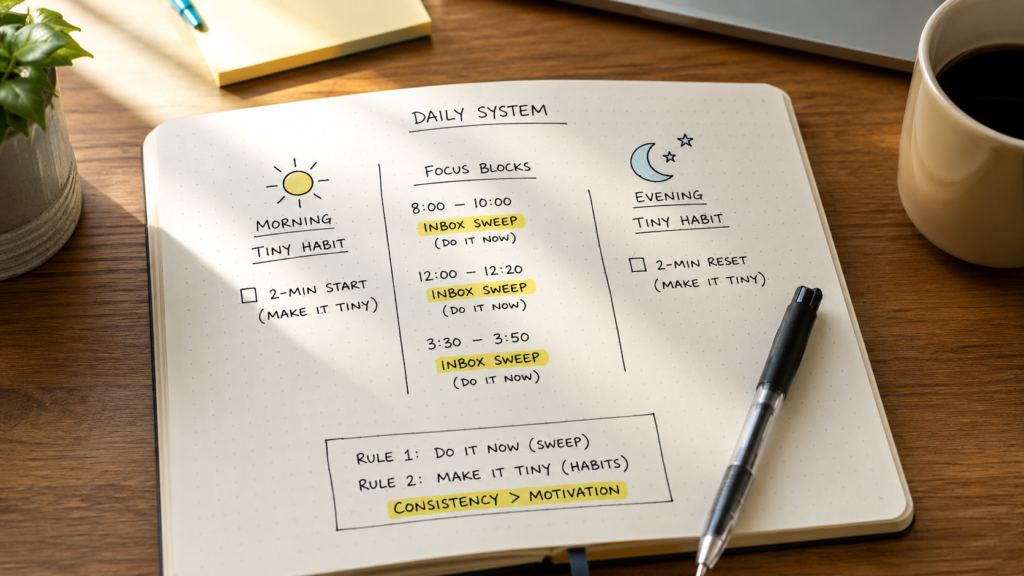
The two versions slot into different moments of the same day, and the combined system takes about a week to feel natural. Here’s the operating pattern.
Morning: your habit gateways fire with their anchored cues — the one page with coffee, the shoes by the door, the three breaths after brushing teeth. Two to six minutes total, and the day’s most important identities have already voted. If you run a morning routine, the gateways simply are its smallest components — the two systems are the same idea at different scales.
Processing windows (2–3 per day): Allen’s rule governs. Sweep the inbox, the messages, the capture list; everything under two minutes gets executed on contact, everything larger gets a home — scheduled into a calendar block, delegated, or listed with a concrete next action. Twenty minutes, hum silenced.
Focused blocks: neither rule fires. Arriving small tasks get one captured line and wait; habit work beyond the gateway happens if scheduled. The two minute rule is a servant of your deep work, never its interruption.
Evening: the last processing sweep closes the day’s loops, and the evening habit gateways (the page, the prep for tomorrow) run on their cues.
Two boundary rules keep the system honest. The rule is not a priority system — it tells you what to do with a task you’re already touching, not which tasks deserve your day. Deciding what deserves the day belongs to your priority tools; a morning spent gleefully clearing forty micro-tasks while the important project waits is efficient procrastination, the most respectable-looking kind. And the rule is not a substitute for elimination — some recurring two-minute tasks shouldn’t be done faster; they should stop existing (unsubscribe, automate, decline). The sharpest practitioners run a monthly glance at their most frequent micro-tasks and retire the ones a rule or a robot could handle.
Expect a specific arc in week one: the first two days feel almost giddy (the small-task backlog collapses, the gateways feel effortless), day three through five bring the counterattack (the urge to scale habits up, the temptation to apply “do it now” mid-focus), and by the weekend the boundaries settle. The lasting change most people report isn’t speed — it’s quiet: fewer open loops humming, fewer standoffs with the couch, and the strange discovery that the person who does things immediately and the person who shows up daily were both hiding inside a two-minute commitment.
When the Two Minute Rule Backfires (Honest Limits)

The rule family has real failure modes, and knowing them in advance is the difference between a tool and a slogan. Four limits matter.
Limit one: processing-rule abuse during deep work. Covered above but worth its own flag because it’s the most common failure: “it only takes two minutes” is the exact phrasing your brain uses to escape hard work. During focused blocks the rule is suspended, full stop. If you notice yourself doing many small legitimate tasks precisely when one large intimidating task is due, you’ve met efficient procrastination — the fix isn’t more rule; it’s naming the avoidance and giving the big task its gateway (version two exists for exactly this moment).
Limit two: gateway habits that never grow. A small minority of people stay at one page forever — not as establishment, but as hiding. The distinction: in the establishment phase (first several weeks), staying tiny is correct. After the gateway is automatic, if the habit never expands and you want the larger outcome, add a gentle scaling prompt: “one page, and I may continue” becomes “one page, then decide about a second.” The growth should feel like permission, not demand — demand is how the original resistance gets rehired.
Limit three: micro-task floods that signal a system problem. If every processing sweep harvests thirty items, the rule is bailing a leaking boat. Chronic floods usually mean upstream problems — too many subscriptions, unclear team processes, requests that should be batched or templated. The rule handles the flow; only elimination shrinks the river.
Limit four: the rule can’t rank importance. Two minutes of trivia and two minutes of consequence look identical to the rule. On heavy days, run your priorities first and let the rule serve inside them — the small stuff fits into the day’s gaps, never the reverse.
None of these limits argue against the rule; they define its jurisdiction. Inside that jurisdiction — small existing tasks during processing, big new habits at their gateways — it remains the highest ratio of life improvement to instruction length in the entire productivity canon.
Common Two Minute Rule Mistakes (That Even Productivity Fans Make)

These are the errors of people who know the rule and still watch it underdeliver.
1. Using only one version and expecting both benefits. GTD readers clear micro-tasks beautifully while their exercise habit stays theoretical; Atomic Habits readers nurse perfect gateways while forty small obligations orbit unfinished. Each camp owns half a tool. Fix: run both deliberately — Allen’s version inside processing windows for existing small tasks, Clear’s version at anchored cues for new big habits. They share a name because they share an enemy, not a mechanism.
2. Letting “two minutes” inflate. The reply becomes a “quick” research errand, the one page becomes “just this chapter,” and within a fortnight the rule governs nothing because everything qualifies. Fix: the kettle test for Allen’s version (finishable before water boils, or it goes on the list), and a literal timer for Clear’s gateways during the first weeks — the constraint is the tool; loosen it and you’re back to negotiating with yourself, which was the original problem.
3. Running do-it-now with no capture system behind it. Without a trusted list for the over-two-minute items, “do it now” quietly becomes “do it now or lose it,” so you start doing everything now out of fear of forgetting — and the rule mutates into permanent reactivity. Fix: the rule only works as the small-task half of a capture habit: under two minutes, execute; over two minutes, one written line with a concrete next action. A bullet journal daily log or any trusted list closes the loop the Zeigarnik effect would otherwise keep open.
4. Scaling the gateway up at the first sign of ease. Day four feels effortless, so one page becomes twenty, the session becomes forty-five minutes — and day nine meets the full-size resistance the gateway existed to avoid, now with a side of “I already failed the bigger version.” Fix: hold the two-minute ceiling for at least two to three weeks, until skipping feels stranger than doing. Overflow is allowed when it happens naturally; commitment stays tiny until showing up is boring.
5. Judging the habit version by early output. “One page a night is 30 pages a month — pathetic,” says the calculator, and the habit gets abandoned for being too small to matter. The calculator is measuring the wrong phase: month one’s product isn’t pages; it’s a person who reads every night, and that person’s year looks nothing like 30 pages a month. Fix: for the first month, track only show-up rate (did the gateway fire?), and let volume remain unmeasured. Identity first, output later — the compounding depends on that order.
FAQ
What is the two minute rule?
It’s two related rules sharing one name. David Allen’s version (from Getting Things Done): while processing your tasks or inbox, anything that takes under two minutes gets done immediately, because tracking it costs more than doing it. James Clear’s version (from Atomic Habits): scale any new habit down to a two-minute version — “read one page,” “put on running shoes” — so starting becomes effortless.
Who invented the two minute rule?
David Allen introduced the original in his 2001 book Getting Things Done, as part of his task-processing workflow. James Clear later adapted the name for habit formation in Atomic Habits (2018), where the two minutes describe the size of a new habit’s starting version rather than a task’s length. Both versions are legitimate and solve different problems — small existing tasks versus big new habits.
Does the two minute rule actually work?
Both versions rest on solid psychology. Allen’s version eliminates the administration and mental looping of tiny deferred tasks — the Zeigarnik effect shows unfinished items keep claiming attention until closed. Clear’s version works because starting, not doing, is where habits fail; a two-minute gateway removes the resistance, and behavior research on tiny, cue-anchored habits shows they become automatic far more reliably than ambitious ones.
When should I NOT use the two minute rule?
During focused, deep work — that’s the rule’s most important boundary. Applied mid-focus, “it only takes two minutes” becomes a self-interruption engine, and attention research shows each switch costs far more than two minutes to recover from. Small tasks that arrive during focus get one line on a capture list and wait for your next processing sweep. The rule serves your priorities; it never overrides them.
How do I use the two minute rule for habits?
Shrink the habit to a version that genuinely takes two minutes — one page, three breaths, shoes on — and attach it to an existing daily cue: “after I pour my coffee, I read one page.” Treat the tiny version as a real finish line, not a trick: showing up is the habit in month one. Hold the two-minute size for a few weeks until it’s automatic, then let it grow naturally.
What tasks count as two-minute tasks?
Genuinely finishable in 120 seconds: a short reply, filing a document, a calendar confirmation, unloading two dishes, booking the appointment whose details you already have. Not: anything requiring research, decision-making, or “quickly looking into” something — those are bigger tasks in disguise and belong on your list with a concrete next action. The honest test: could you finish before a kettle boils?
The Bottom Line
The two minute rule earns its fame by attacking the gap between deciding and doing from both ends: Allen’s version closes it for the small tasks that clutter your head, and Clear’s version closes it for the big habits that die at the starting line. Run them together — do-it-now inside your processing sweeps, tiny gateways on anchored cues, and neither during deep work — and the change arrives as quiet: fewer open loops, fewer standoffs, more days that simply start. Pick your most avoided habit tonight, shrink it until it fits inside two minutes, and let tomorrow’s first tiny vote get cast.