

How to stop procrastinating, You know the deadline matters. You want to do the work. And you’re reorganizing a drawer anyway, with a low hum of dread underneath. If “just start” worked, you’d have started — so this guide skips the pep talk and gives you what procrastination research actually supports: why your brain does this, and a layered system of fixes that work even on the days motivation doesn’t show up.
To stop procrastinating, treat it as an emotion problem, not a time problem: you delay tasks to escape how they make you feel — bored, anxious, confused, or judged. The working fixes lower that emotional cost: shrink the task to a two-minute starting version, define the exact next action, remove friction and distractions in advance, use short timed work sprints, and forgive past delays, which research shows reduces future ones.

Key Takeaways
- Procrastination is emotion regulation, not laziness — you’re escaping a feeling (anxiety, boredom, confusion, fear of judgment), and the escape is what gets reinforced.
- The task you’re avoiding is almost always vague, big, or scary; converting it into one concrete two-minute next action removes the fog your brain flees from.
- Environment beats willpower: the phone in another room and the document already open do more than any motivation technique.
- Timed sprints (like 25-minute Pomodoros) work because they replace “finish this mountain” with “survive 25 minutes,” which your brain will agree to.
- Self-forgiveness measurably reduces future procrastination; self-punishment increases the negative feelings that caused the delay in the first place.
- Chronic, life-damaging procrastination sometimes signals depression, anxiety, or ADHD — a system helps, but persistent severe patterns deserve professional attention.
Why You Procrastinate (It’s Not Laziness, and the Research Is Clear on This)
Procrastination is your brain choosing short-term mood repair over long-term goals — a definition with decades of evidence behind it, and one that changes what fixing it looks like. The researcher most associated with this framing, Dr. Tim Pychyl of Carleton University’s Procrastination Research Group, puts it bluntly: procrastination is an emotion-regulation problem, not a time-management problem. Dr. Fuschia Sirois of Durham University, whose work spans health and procrastination, describes the same mechanism: certain tasks generate negative feelings — anxiety, boredom, self-doubt, resentment, confusion — and avoidance delivers instant relief. That relief is the trap. Your brain registers it as a reward, and rewarded behaviors repeat. You’re not failing to manage time; you’re succeeding, repeatedly, at escaping discomfort.

The engine underneath is a bias behavioral scientists call temporal discounting — the human tendency to value immediate outcomes far more than future ones. Tonight’s relief is vivid and now; the deadline’s pain is abstract and later. Neuroimaging work adds a poetic detail: when people think about their future selves, brain activity patterns resemble those for thinking about strangers. You’re not lazily dumping work on yourself — you’re dumping it on someone your brain half-believes is another person. (Hal Hershfield’s research at UCLA on future-self continuity found that people who feel more connected to their future selves save more money and procrastinate less.)
Two more findings complete the picture. First, procrastination is task-specific and feeling-specific. Nobody procrastinates everything; you procrastinate tasks with particular emotional signatures — usually vague (“figure out taxes”), boring, meaningful-enough-to-fear-judgment, or lacking obvious starting points. Identifying which feeling a task triggers tells you which fix to reach for. Second, the cost is bigger than late work. Sirois’s health research links chronic procrastination to higher stress, worse sleep, delayed medical care, and cardiovascular risk factors — the avoided task doesn’t disappear; it runs in the background as a stress process. Which is also the hopeful part: the fix isn’t becoming a different person. It’s lowering the emotional cost of starting, and that’s an engineering problem. The American Psychological Association has a readable overview of this research on its procrastination page .
The First-Aid Kit: Five Fixes for the Task You’re Avoiding Right Now

When you’re mid-avoidance, you don’t need a philosophy — you need a crowbar, and these five are ordered from fastest to strongest. Use the first one that gets you moving.


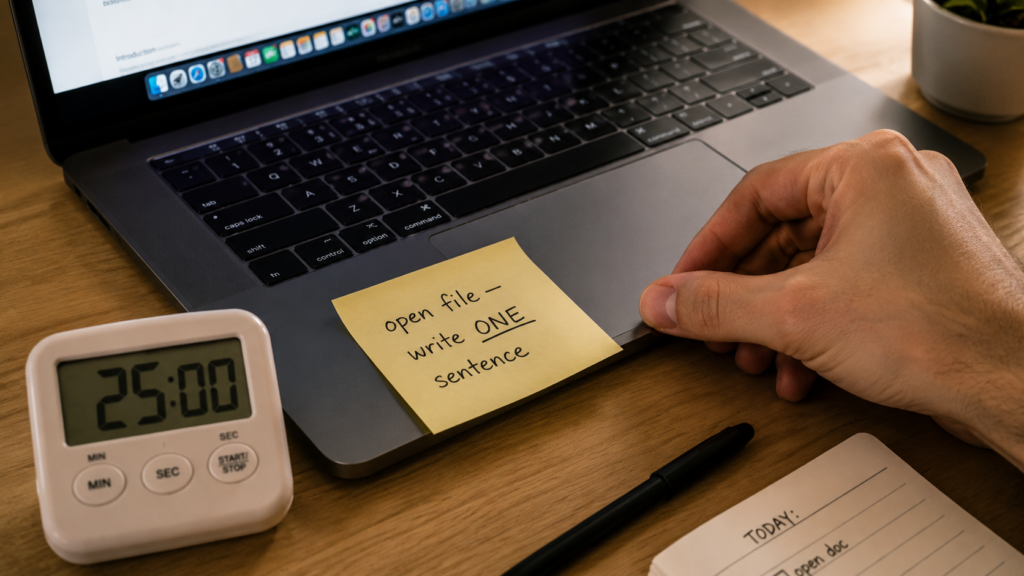
1. Shrink the entry: the two-minute version. Don’t start the report — open the document and write one ugly sentence. Don’t do the taxes — find last year’s return and put it on the desk. The rule, popularized in slightly different forms by David Allen (Getting Things Done) and James Clear (Atomic Habits): scale the task down until starting is easier than continuing to avoid it. This works because the dread you feel is attached to the whole task; the two-minute version slips under the dread. And starting has a documented tailwind — the Zeigarnik effect, psychology’s old finding that begun-but-unfinished tasks nag at memory and pull you back. Getting a task from 0% to 2% changes its psychological status entirely.
2. Define the next physical action. Vagueness is procrastination fuel: “work on the presentation” gives your brain nothing to grip, so it slides off toward the fridge. Rewrite the task as the next physical, visible action: “open slides file and draft three section titles.” If you can’t name the next action, that’s diagnostic — the real task is “spend ten minutes figuring out the first step,” and that’s what goes on the list.


3. Do a 25-minute sprint with a visible timer. The Pomodoro technique — 25 minutes on, 5 off — works for a specific psychological reason: it replaces the unbounded commitment (“work on thesis,” which means forever) with a bounded, survivable one. Your brain refuses mountains and accepts intervals. The permission structure matters: you’re allowed to stop at the bell, which paradoxically makes continuing common. One sprint counts as victory on a bad day.
4. Remove the escape routes before you sit down. Phone in another room (not face-down — another room; studies from the University of Texas found a phone’s mere visible presence taxes available cognition), distracting sites blocked for the sprint, only the needed document open. This isn’t about discipline — it’s about raising the cost of the escape until the task becomes the path of least resistance. Willpower is a lousy wall; distance is a great one.
5. Name the feeling out loud. Before the crowbar, sometimes the lock: pause and finish the sentence “I’m avoiding this because I feel ___.” Anxious it won’t be good enough. Bored senseless. Confused about what’s wanted. Resentful I was assigned it. Affect-labeling research (Matthew Lieberman’s lab at UCLA) shows that naming an emotion measurably reduces its intensity — and each feeling points at its own remedy: anxiety wants a lower bar (“ugly first draft is the assignment”), confusion wants a clarifying question sent to someone, boredom wants a sprint with a reward at the bell, resentment sometimes wants an honest conversation about the task itself.
The Long Game: Building a Life That Produces Less Procrastination
First aid gets today’s task moving; the structural layer makes avoidance rarer next month, and it’s built from five habits installed over weeks, not minutes.
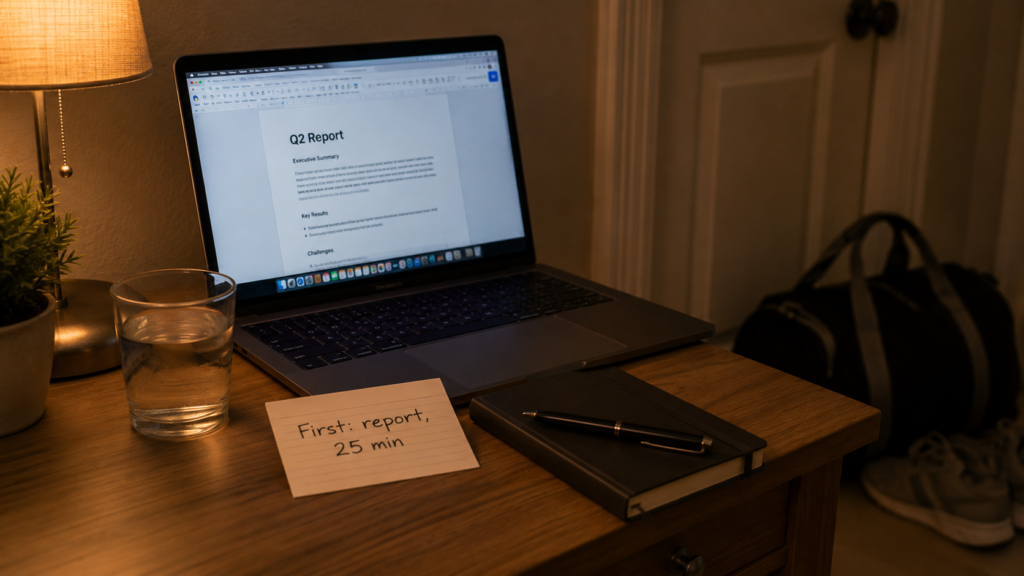
Design tomorrow the night before. Each evening, write tomorrow’s one most-important task and its concrete first action, and stage the environment: document open on the laptop, gym bag by the door, materials on the desk. Morning-you inherits a decision-free runway — and decision-free is procrastination-resistant, because every open decision (“what should I work on?”) is an off-ramp. This pairs naturally with time blocking: give the most-avoided task the first protected block, when your self-control budget is freshest.
Use implementation intentions for your known avoidance zones. The format, from Peter Gollwitzer’s extensively replicated research: when [situation], I will [action]. “When I open my laptop after lunch, I will write for 25 minutes before opening email.” “When I notice I’ve picked up my phone mid-task, I will put it in the drawer and do two more minutes.” Meta-analyses covering nearly a hundred studies found these if-then plans produce medium-to-large improvements in follow-through — remarkable for a technique that costs one written sentence. They work because they pre-load the decision, so the moment of temptation arrives already answered.
Make your future self less of a stranger. Since temporal discounting runs on disconnection from future-you, deliberately reconnect: before deferring a task, spend ten seconds vividly imagining the specific evening you’re creating — Thursday, 11 p.m., the unwritten report, that particular dread. Hershfield’s research found even brief future-self vividness exercises shift present choices. Some people keep it concrete with a calendar note addressed to themselves: “Hi. You left this for me. — Thursday You.”
Build one external accountability loop. Procrastination thrives in privacy; visibility starves it. The options in ascending strength: telling one person your deadline, a weekly progress message to a friend, body-doubling (working alongside someone, in person or on a video call — disproportionately effective for ADHD brains), and stakes-based commitment devices where missing a deadline costs you money. Choose the mildest version that actually changes your behavior — and notice that the mechanism isn’t shame; it’s making the task socially real.
Practice deliberate self-forgiveness after lapses — this one is counterintuitive and evidence-backed. A study by Michael Wohl and colleagues at Carleton followed students across two exams: those who forgave themselves for procrastinating on the first exam procrastinated less on the second. The mechanism runs straight through the emotion-regulation model: guilt and self-punishment add negative feeling to the task, and negative feeling is precisely what procrastination escapes from — so beating yourself up literally reloads the gun. The working script after a lost day: “That happened. It doesn’t decide tomorrow. What’s the two-minute version tonight?” Self-compassion here isn’t softness; it’s cutting the fuel line.
Procrastination Types: Match the Fix to Your Actual Pattern
“Procrastinator” is not one species — the avoidance has flavors, and the fix that saves one type does nothing for another, which is why generic advice keeps failing you. Find your primary pattern below (most people are a blend with one dominant strain).
| Type | What it looks like | Core feeling | First-choice fixes |
|---|---|---|---|
| The Perfectionist | Can’t start until conditions/skills are “ready”; endless research and polishing | Fear the output won’t match the standard | Ugly-first-draft rule; timeboxed deadlines; “done is the assignment” |
| The Overwhelmed | Task feels like a wall; freezes at the size | Confusion + dread; no visible entry | Next-physical-action rewrite; break into 2-minute steps; ask one clarifying question |
| The Bored Avoider | Endless capacity for interesting work; allergic to admin and routine | Understimulation | Sprints with rewards at the bell; batch boring tasks with music/podcast; body-doubling |
| The Deadline Adrenaline User | “I work best under pressure”; manufactures crises | Numbness until stakes spike | Artificial early deadlines with real stakes; accountability partner; honest audit of the quality cost |
| The Fear-of-Judgment Delayer | Delays anything that will be seen and evaluated — sending, publishing, asking | Anticipated criticism | Shrink the audience (share with one kind reader first); separate making from showing; exposure in small reps |
Three notes on using the table. The perfectionist should know their pattern has research teeth: perfectionistic concerns (fear of others’ judgment of flaws) correlate with procrastination far more than high standards themselves do — the standard isn’t the problem; the anticipated verdict is. The deadline adrenaline user deserves one honest confrontation: the belief “I do my best work under pressure” almost never survives an audit — compare your rushed work against your rare early work and count the errors; what pressure actually provides is not quality but permission to stop deliberating, and an artificial deadline provides the same permission without the all-nighter. And the overwhelmed type should hear the kindest finding in this literature: your freeze isn’t weakness — it’s an accurate signal that the task, as currently defined, has no graspable handle. Redefining it is the work.
One boundary, stated plainly because it matters: if procrastination is chronic, severe, and damaging your studies, career, finances, or health despite genuine system-building — especially alongside low mood, constant anxiety, or lifelong attention struggles — it may be a symptom rather than a habit. Depression, anxiety disorders, and ADHD all wear procrastination as a mask, and no productivity system treats an underlying condition. A conversation with a doctor or therapist is the strong move, not the defeated one.
Common Mistakes People Make When Trying to Stop Procrastinating
These are the traps that catch people who’ve read the books and genuinely tried — the second-order failures.
1. Waiting to feel ready, motivated, or “in the mood.” The causality runs backward: motivation mostly follows action rather than preceding it — start badly for five minutes and the mood often arrives mid-task, summoned by progress. Treating motivation as a prerequisite means the tasks that generate the least enthusiasm (i.e., the avoided ones) wait forever. Fix: adopt “action first, feelings follow” as operating policy, with the two-minute version as the ignition that requires no mood at all.
2. Building elaborate productivity systems as premium procrastination. The new app, the color-coded planner migration, the fourth reorganization of the task list — it feels responsible and is often avoidance wearing a productivity costume, complete with the same relief mechanism. Fix: apply the one-question audit: “is this system work, or is it the work?” New tools get adopted between projects, never in place of the currently avoided task. If you’ve researched productivity for more than an hour this week, close this tab after the article and go do the two-minute version.
3. Scheduling the avoided task for your worst hours. The dreaded report goes to “tonight, after everything else” — handing your hardest emotional task to your most depleted self, then reading the inevitable failure as a character flaw. Self-control research consistently shows regulation capacity sags with fatigue. Fix: the most-avoided task gets your best hour — for most people, early in the day, before the inbox — and gets it as a protected block. Depleted hours are for shallow work.
4. Going cold-turkey on all avoidance at once. Deciding that starting Monday you’ll confront every avoided task — taxes, the difficult email, the half-finished course, the garage — stacks emotional loads the way crash diets stack hunger, with the same rebound. Fix: one avoided task at a time, oldest-and-heaviest first or easiest-first (either sequencing works; pick by temperament), with the others formally parked on a dated list so they stop haunting the periphery.
5. Confusing strategic delay with procrastination and punishing both. Not every deferral is avoidance — deciding to sleep before answering an inflammatory email, or letting a half-formed idea sit a week, is judgment, not weakness. Punishing all delay teaches you to distrust your own pacing and adds guilt-noise that masks the real signal. Fix: the honest test is feeling and function — strategic delay feels calm and has a reason and a date; procrastination feels like flinching and has excuses. Keep the first, treat the second.
FAQ
Why do I procrastinate even when I want to do the task? Because procrastination isn’t about wanting — it’s your brain escaping a feeling the task triggers: anxiety about quality, confusion about where to start, boredom, or fear of judgment. The escape brings instant relief, which reinforces the pattern. Wanting the outcome and avoiding the emotion coexist perfectly. The fix targets the feeling: shrink the task, define the first action, and lower the stakes of starting badly.
Is procrastination a mental illness? No — it’s a common human behavior pattern, not a diagnosis. But chronic, severe procrastination can be a symptom of conditions like depression, anxiety disorders, or ADHD, especially when it damages work, studies, or health despite real effort to change. If that describes your pattern, a doctor or therapist is the right next step; productivity systems can’t treat an underlying condition.
What is the 2-minute rule for procrastination? Scale any avoided task down to a version that takes about two minutes — “write the report” becomes “open the document and write one sentence.” Starting is the hardest part because dread attaches to the whole task; the tiny version slips underneath it. Once begun, tasks tend to pull you forward — unfinished work nags at the brain in a useful way psychologists call the Zeigarnik effect.
Does the Pomodoro technique actually work for procrastination? For many people, yes — because it fixes the specific problem of unbounded commitment. “Work on the thesis” means forever, and the brain refuses; “25 focused minutes, then a guaranteed break” is survivable, and the brain agrees. The permission to stop at the bell is the active ingredient. It works best for boredom- and overwhelm-driven avoidance, less well when the block is fear of judgment.
How do I stop procrastinating at night and go to sleep? Bedtime procrastination — delaying sleep to reclaim personal time after a demanding day — responds to structure more than willpower: set a “shutdown alarm” 45 minutes before target sleep, make the phone charge outside the bedroom, and deliberately schedule real leisure earlier in the evening so the night doesn’t feel like your only free hours. If your days leave zero time that’s yours, that scarcity is the actual problem to fix.
Why does self-forgiveness reduce procrastination? Because guilt is fuel for the cycle. Procrastination escapes negative feelings — so when you punish yourself for yesterday’s avoidance, you load the task with even more negativity, making it harder to face today. A Carleton University study found students who forgave themselves for procrastinating on one exam procrastinated measurably less on the next. Forgive, then immediately do the two-minute version — compassion plus action, not compassion instead of it.
Closing
You stop procrastinating not by becoming more disciplined but by making tasks cheaper to start: name the feeling, shrink the entry to two minutes, stage the environment the night before, and forgive the lost days fast enough that guilt never joins the pile. The system works precisely because it doesn’t require you to feel like working. Pick the task that’s been haunting you longest, write its two-minute version on paper right now — and do it before this tab closes.
Don’t Miss: