

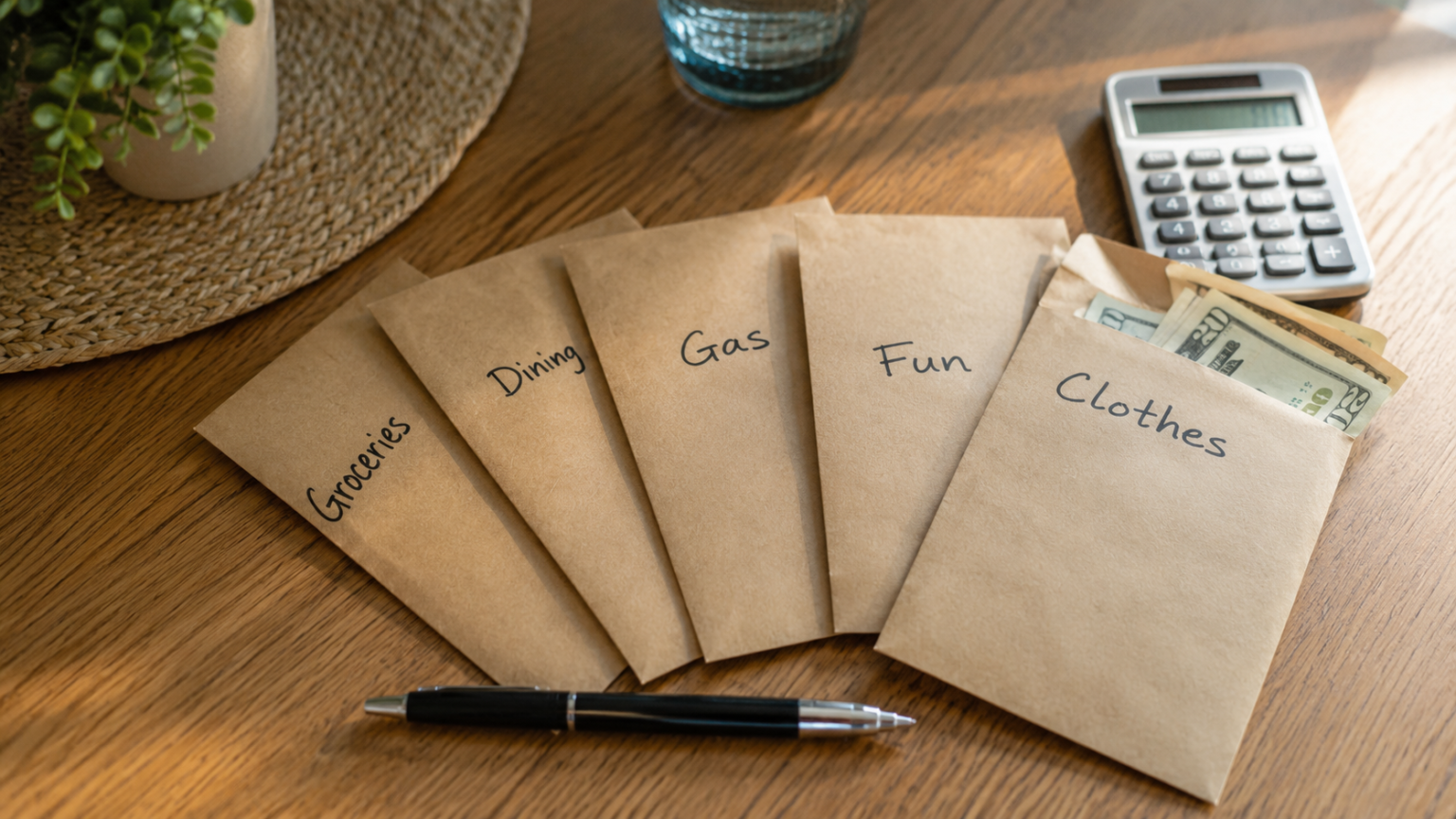
You have three budgeting apps on your phone, and you still can’t explain where $400 went last month. Meanwhile, your grandmother ran a household on cash in labeled envelopes and never overdrafted once in her life. This guide covers the cash envelope system — why paying with physical money changes spending in ways no app notification can, how to set it up in an evening, and the hybrid version for a world where rent gets paid online.

The cash envelope system is a budgeting method where you withdraw your spending money in cash at the start of each month and divide it into labeled envelopes — groceries, gas, dining out, fun. You pay for each category only from its envelope, and when an envelope is empty, that category’s spending stops until next month. Fixed bills stay digital; the envelopes handle the variable spending where budgets actually leak.
Key Takeaways
- The cash envelope system assigns physical cash to spending categories in labeled envelopes; an empty envelope means that category is done for the month.
- It targets only your variable spending (groceries, dining, fun, gas) — fixed bills like rent and utilities stay on autopay as normal.
- Paying with cash triggers a measurable “pain of paying” that cards and taps are specifically designed to numb — which is why the method cuts spending where apps fail.
- Most people need only 4–6 envelopes; more than eight becomes a part-time job and gets abandoned.
- The hybrid version — cash for your 2–3 leakiest categories, digital for the rest — captures most of the benefit with a fraction of the hassle.
- The system’s real product is a hard stop: for the first time, overspending becomes physically impossible instead of merely discouraged.
Why Paying With Cash Works When Apps Don’t: The Pain of Paying

The cash envelope system works because of a psychological mechanism that budgeting apps can’t replicate: physical cash makes spending hurt a little, and that small hurt changes decisions in real time. Behavioral economists call it the “pain of paying” — a term from research by Drazen Prelec and Duncan Simester at MIT, whose well-known study found participants were willing to pay substantially more for the same items when using a credit card versus cash. The card didn’t just delay the payment; it anesthetized it. Handing over two $20 bills and receiving coins back is a felt event. Tapping a card is designed to be nothing at all — and the payments industry has spent two decades making it even more frictionless, because friction reduces spending and they profit from the opposite.
Apps sit on the wrong side of this timeline. A budgeting app tells you after the transaction that you’ve overspent dining out — useful information, delivered to a person who has already eaten the meal. The envelope intervenes before: you open it at the restaurant, see $18 remaining with nine days left in the month, and order differently. The feedback isn’t a red number in a weekly report; it’s the physical thinness of the envelope in your hand, updated live, impossible to ignore and impossible to argue with.
There’s a second mechanism stacked on the first: partitioning. Research on mental accounting — the field pioneered by Nobel laureate Richard Thaler — shows that people treat money differently depending on which mental “account” it sits in, and that physically dividing resources into smaller pools slows consumption of each pool. One study famously found people ate fewer cookies when the same number came in separate wrappers: each partition creates a decision point. Envelopes industrialize this. Your $500 of monthly spending money stops being one blurry pool that mysteriously drains and becomes five clear pools with five visible levels, each asking “are you sure?” every time you open it.
Highly Related

None of this means apps are useless — they’re excellent at tracking, categorizing history, and managing fixed bills. But tracking is a rearview mirror. The envelope system is a brake pedal, and brake pedals are what most struggling budgets are missing. If you’ve ever finished a month baffled by your own bank statement despite having a perfectly good app installed, you’re the person this method was built for.
Setting Up Your Envelopes: The 6-Step Launch (One Evening, One ATM Trip)

The full setup takes one evening plus one bank visit, and the design decisions you make here determine whether the system lasts six days or six months. Here’s the sequence.
Step 1: Separate fixed from variable. Pull last month’s statement and split every expense into two lists. Fixed and online-native: rent, utilities, insurance, subscriptions, phone, debt payments — these stay digital on autopay; envelopes never touch them. Variable and leak-prone: groceries, dining out, gas, entertainment, personal/fun money, household stuff, kids’ incidentals. This second list is envelope territory. Most people discover their variable spending is $400–900 a month — a shockingly small pool to be causing most of the budget chaos, which is exactly why targeting it works.
Step 2: Pick 4–6 categories, not twelve. The classic starter set: Groceries, Dining Out, Gas, Fun/Personal, and one wildcard for your personal weakness (clothes, hobbies, coffee). Every additional envelope adds a sorting decision at the ATM and a “which envelope does this come from?” negotiation at every purchase. Four to six covers 90% of variable leakage; twelve creates a filing job you’ll quit by week three.
Step 3: Set amounts from your real history, minus 10–15%. Look at what you actually spent per category over the last two or three months — not what a disciplined stranger would spend — and set each envelope slightly below the average. The envelope’s hard stop does the disciplining; your job at setup is honesty. Cutting groceries from a real $600 to an aspirational $350 doesn’t create savings; it creates a mid-month system failure and a shame spiral.
Step 4: One withdrawal, on payday, already divided. Withdraw the full envelope total in one monthly (or twice-monthly, matching your pay cycle) ATM trip. Ask for denominations that split cleanly — twenties and tens. Fill the envelopes the same day; cash that sits loose in a wallet joins the general blur the system exists to prevent. Write the amount and month on each envelope’s front.
Step 5: Establish the two operating rules. Rule one: the envelope is the wallet for that category. Grocery shopping means the grocery envelope comes with you — the whole method fails if the cash stays home and the card comes out “just this once.” Rule two: empty means done. No topping up from other envelopes without a deliberate, written trade (more on borrowing rules below). The hard stop is the entire product; soften it and you’ve built a decorative filing system.
Step 6: The 60-second weekly pulse. Once a week, glance at the levels and jot four numbers on the envelope backs. That’s the whole maintenance load. If you run a zero-based budget already, the envelopes simply become the cash execution layer of categories you’ve already planned — the two systems were made for each other. The CFPB’s free budgeting worksheets pair well with this setup step if you want printable support.
Total setup cost: about ninety minutes, a pack of envelopes, and one slightly awkward ATM withdrawal. Compare that to the twenty minutes a week a tracking app requests forever while changing nothing at the register.
The Hybrid System: Cash Envelopes in a Tap-to-Pay World
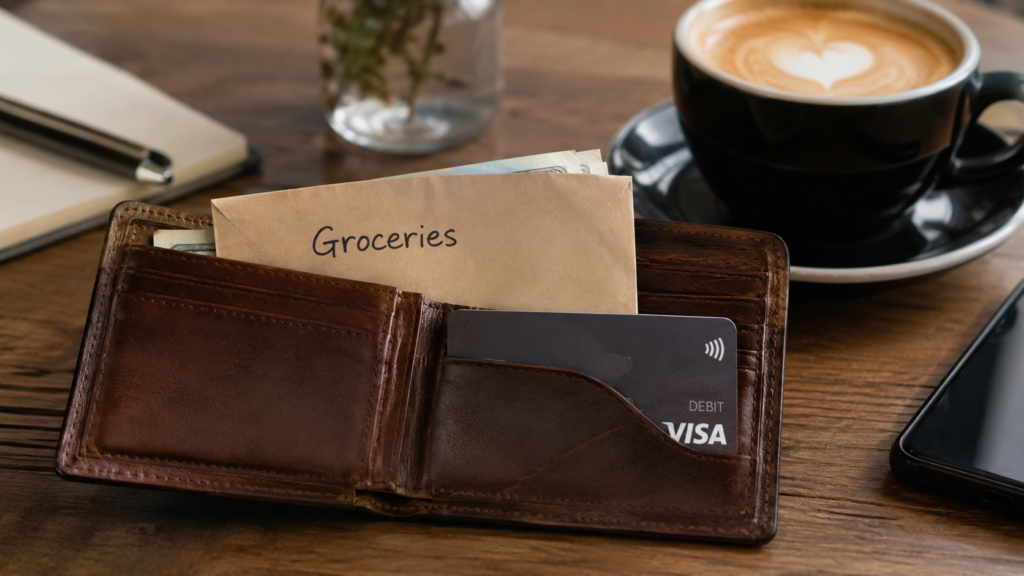
The most common objection to cash envelopes — “nobody uses cash anymore” — is real, and the answer isn’t abandoning the method; it’s deploying it surgically. Here’s the honest comparison, then the hybrid build.
| Full cash envelopes | Digital envelope apps | Hybrid (recommended) | |
|---|---|---|---|
| Pain of paying | Maximum — every purchase felt | Weak — same tap, plus a notification | Strong where it matters |
| Hard stop | Absolute — empty is empty | Soft — apps warn, cards still work | Absolute for problem categories |
| Online purchases | Can’t handle them | Handles everything | Digital categories cover them |
| Convenience | Low — ATM trips, exact change | High | Medium |
| Rewards/cashback | Lost on cash purchases | Kept | Mostly kept |
| Best for | Serious overspending, debt payoff | Naturally disciplined trackers | Almost everyone else |
The hybrid build: identify your two or three leakiest categories — the ones where last month’s number genuinely surprised you (for most people: dining out, groceries, and one personal vice category) — and run only those in physical cash. Everything else stays digital: fixed bills on autopay, online shopping through a checking account, stable categories tracked in whatever app you like. You get the brake pedal exactly where you keep crashing, without pretending it’s 1985 at the pharmacy.
Two refinements make the hybrid sing. First, the online-spending envelope trick: for categories that must be digital but still leak (looking at you, one-click shopping), keep a paper envelope holding not cash but a handwritten running balance — “$80 → bought book $22 → $58.” It’s weaker than cash but far stronger than nothing, because it forces the pre-purchase arithmetic that one-click checkout was engineered to eliminate. Second, the rewards objection, answered honestly: yes, cash purchases forfeit 1–2% cashback. But if a category runs 15–30% over budget on cards — which is what the Prelec-Simester research suggests happens — you’re paying $30 of overspending to earn $2 of rewards. Cashback math only wins after the spending is controlled; earn your way back to the card category by category, as each one stays on budget for three consecutive months.
A note for couples: envelopes are the rare budgeting method that makes money visible to both partners without an app login. A shared grocery envelope on the counter is a live, neutral dashboard — no one has to nag, because the envelope reports for itself. Many couples find the method defuses money friction for exactly this reason: the hard stop is the system’s rule, not one partner’s.
Living With the System: Borrowing Rules, Leftovers, and Month Two
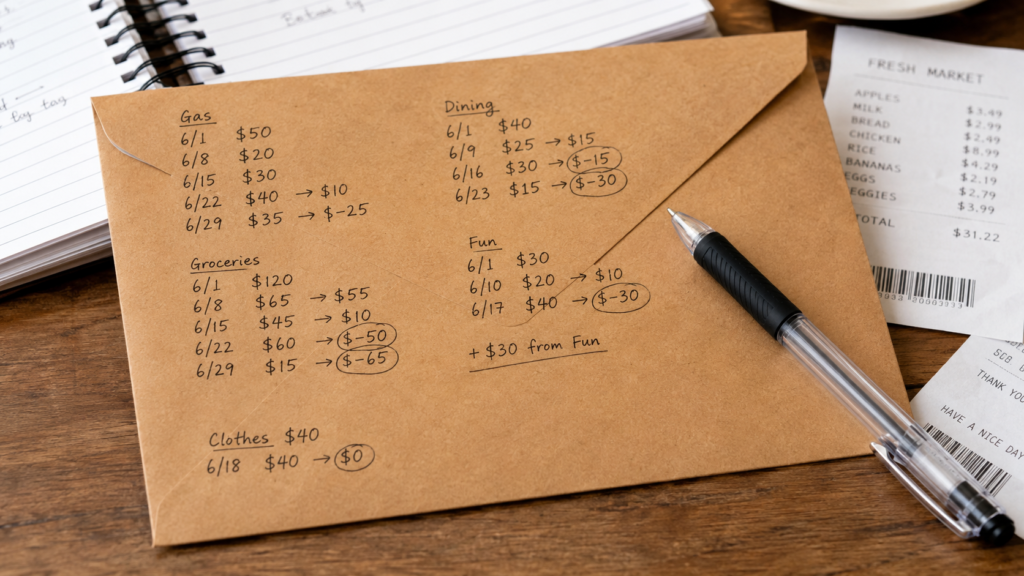
The envelope system’s first month runs on novelty; its survival depends on how you handle the three situations every user hits — the empty envelope, the leftover cash, and the irregular expense.
When an envelope runs dry mid-month, you have exactly three legitimate moves. Move one: stop spending in that category — the default, and genuinely the point; discovering that “we can’t eat out again until the 1st” is survivable is half the method’s education. Move two: an explicit trade — take $30 from Fun and write the transfer on both envelopes, out loud if you share finances. Trades are legal because they’re conscious and zero-sum; the total never grows. Move three (rare): declare the budget itself wrong — if groceries empties three months running despite honest effort, the envelope was underfunded; fix it at the next monthly setup, not mid-month. What’s never legal: the silent card swipe that “doesn’t count.” One invisible exception rebuilds the exact blur you’re escaping.
When an envelope has money left over, don’t let it evaporate. Leftovers are the system’s dividend, and they deserve a destination decided in advance: sweep them to debt payoff, to a sinking fund (leftover cash is the painless way to fund next December’s gifts), or into a visible “wins” jar that becomes something fun each quarter. Some people roll leftovers forward within the same envelope — legitimate for lumpy categories like clothing, but for weekly categories like dining, sweeping keeps each month clean and keeps the win visible. What matters is that surplus cash gets assigned, because unassigned cash rejoins the blur.
Irregular and annual expenses need their own lane. Car registration, holiday gifts, back-to-school — these aren’t monthly envelopes; they’re sinking funds, saved monthly but spent rarely. Keep them separate from the spending envelopes (a different color, a different drawer, or better, a savings account) so a fat “Christmas” envelope in March doesn’t tempt a raid. The envelope system handles the month; sinking funds handle the year; together they cover the whole calendar.
Expect month two to feel worse than month one — that’s the system working. Month one runs on enthusiasm and slightly padded amounts. Month two is when the dining envelope empties on the 19th and the method stops being a craft project and starts being a mirror. This is the moment most quitters quit, and the moment the data starts paying: every early-empty envelope is a precise, dollar-denominated report on where your money actually wants to go. Adjust the amounts, renegotiate the trades, and give the system ninety days — the length habit research suggests new financial routines need before they stop requiring effort. Security note, briefly: monthly envelope cash is usually a few hundred dollars — keep envelopes home in a consistent spot, carry only the day’s relevant envelope, and treat lost-cash risk honestly (it’s real but small, and for most people far smaller than the monthly card overspend they’re currently not counting).
Common Cash Envelope Mistakes (That Even Committed Users Make)

Past the obvious “don’t cheat with the card,” these are the second-order failures that kill working systems.
1. Putting fixed bills in envelopes. Enthusiasts withdraw rent in cash for “consistency” — creating security risk, payment hassle, and zero behavioral benefit, since rent was never the leak. Fixed bills are already controlled by being fixed. Fix: envelopes are exclusively for variable, decision-based spending; everything with a due date stays digital and automated.
2. Setting week-one amounts from your fantasy self. The most common killer: funding groceries at $350 because that’s what disciplined people spend, when your real average is $580. The envelope empties on the 14th, the system “fails,” and the card returns as rescue. Fix: fund from your documented three-month average minus at most 10–15%. Let the hard stop create the reduction gradually — cut another 5–10% each month the envelope survives.
3. Running the system without your partner’s buy-in. One partner launches envelopes; the other keeps swiping a shared card. The categories double-spend, the envelopes “lie,” and the method takes the blame for what is actually a communication gap. Fix: envelopes for shared categories require a shared launch — one conversation, joint amounts, and both people spending from the same physical envelope. Personal-fun envelopes stay individual and unaudited; that privacy valve prevents the system from becoming surveillance.
4. Treating the envelope as a target instead of a ceiling. Month’s end arrives, the fun envelope holds $40, and it gets spent because it’s there — converting a spending cap into a spending quota. Fix: pre-commit every envelope’s leftover destination at setup (debt, sinking fund, wins jar). A ceiling with a sweep rule ratchets spending down; a ceiling without one quietly becomes the floor.
5. Abandoning the whole system over one blown category. The dining envelope explodes during a birthday week, and the response is “envelopes don’t work for me” — discarding four functioning categories over one bad data point. Fix: adopt the never-miss-twice mindset from habit building: one blown envelope is information, not verdict. Patch it with a written trade, note the cause on the envelope back, and let the other categories keep compounding. Systems survive on recoveries, not on perfect months.
FAQ

How does the cash envelope system work?
At the start of each month, you withdraw your variable spending money in cash and divide it into labeled envelopes — groceries, gas, dining out, fun. Each purchase in a category comes only from its envelope, and when an envelope is empty, that spending stops until next month. Fixed bills like rent stay on autopay; the envelopes only control the flexible spending where budgets leak.
How many cash envelopes should I have?
Four to six for almost everyone: groceries, dining out, gas, fun/personal, plus one for your personal weak spot. Every extra envelope adds sorting work and decision friction, and systems with ten or twelve envelopes usually get abandoned within a month. You can always add a category later; starting lean is what keeps the habit alive.
What if I need to buy something online?
Run a hybrid: keep your leakiest 2–3 categories in physical cash and leave online-native spending digital. For digital categories that still leak, use a “paper balance” envelope — write the starting amount and subtract each purchase by hand. It’s weaker than cash but restores the pre-purchase math that one-click checkout removes.
Does the cash envelope system actually save money?

The mechanism is well-supported: research on the “pain of paying” (notably Prelec and Simester at MIT) found people spend significantly more with cards than cash for identical purchases, because cards numb the transaction. Envelopes add a hard stop on top — overspending becomes physically impossible, not just discouraged. Most users see their targeted categories drop 10–25% in the first two months.
What do I do with leftover money in an envelope?
Assign it before the month starts: sweep it to debt payoff, into a sinking fund for irregular expenses, or into a visible rewards jar. For lumpy categories like clothing you can roll it forward. What you shouldn’t do is spend it because it’s there — that turns your spending ceiling into a quota — or let it drift back into general cash, where it rejoins the blur.
Is the cash envelope system safe? What if I lose the cash?
The risk is real but small in practice: envelopes hold a few hundred dollars, stay home in a consistent spot, and only the day’s relevant envelope travels with you. Compare that honestly against the alternative — for most people, uncontrolled card spending costs more every single month than a lost envelope would cost once. If cash anxiety is a dealbreaker, the hybrid version keeps amounts minimal.
The Bottom Line
The cash envelope system endures because it fixes the exact thing apps can’t: it makes spending felt before it happens and impossible after the money’s gone. Set up four to six envelopes from your real numbers, run the hybrid where digital life demands it, and let the hard stop teach what a decade of notifications couldn’t. Pull last month’s statement tonight, circle your three leakiest categories — and put this month’s version of them in paper.