


Spend ten minutes at the end of your workday writing tomorrow’s plan. Empty every open task onto paper, choose one task that matters most, add two supporting tasks, then give each one a specific time or trigger — “if it’s 9 a.m. and I’m at my desk, I open the client file.” Write the first physical action, and set out whatever you’ll need. Do it before you leave your desk, not in bed.
The Short Version
Your Morning Brain Is the Worst Person to Choose Your Priorities

Planning in the morning feels responsible, but it spends your best cognitive hour on a decision you could have made for free the night before. There’s a second problem nobody mentions: the version of you that plans at 8 a.m. is also the version that has to execute at 8:05, which means every ambitious choice is immediately negotiable. Evening-you has no such conflict of interest. Evening-you can hand tomorrow a job and walk away.
Most advice frames this as a productivity trick. It isn’t. It’s an offloading protocol, and the research is unusually clean about what’s actually happening. In a set of six experiments published in the Journal of Personality and Social Psychology, psychologists E.J. Masicampo and Roy Baumeister had people write about two important unfinished tasks, then read the opening chapters of a novel. Roughly 65% of the group that had no plan reported their attention drifting during the reading. Among people who’d written a specific plan for the same unfinished tasks, that dropped to 33%. Comprehension scores followed: the no-plan group averaged 6.13 correct out of eight, planners 6.94 — statistically identical to people whose tasks were already finished.
❗ IMPORTANT
Nobody in that study did a single minute of the actual work. The planners hadn’t studied, exercised, or sent one email. Writing a specific plan was enough to switch off the mental nagging. That’s the whole mechanism — and it’s why night-before planning buys you a better morning even when nothing gets done in the evening.
The sleep side has evidence too. Researchers at Baylor University ran 57 people through overnight polysomnography — the electrode-based gold standard for measuring sleep, not a self-report survey. Half spent five minutes before lights-out writing what they needed to do over the coming days; half wrote about what they’d already finished. The to-do list writers fell asleep in about 16 minutes on average. The completed-activity group took about 25. Nine minutes doesn’t sound dramatic until you notice it’s roughly the margin sleep medications post in clinical trials.


One detail from that study matters more than the headline: the more specific participants made their tasks, the faster they fell asleep. “Go to the grocery store” was slower than “buy oranges.” Vagueness is what keeps the loop spinning, because a vague task still requires a decision, and your brain knows it. That single finding should change how you write every line of tomorrow’s list. Read the full Baylor summary of the sleep study if you want the methodology.
How to Plan Your Day the Night Before in 10 Minutes Flat
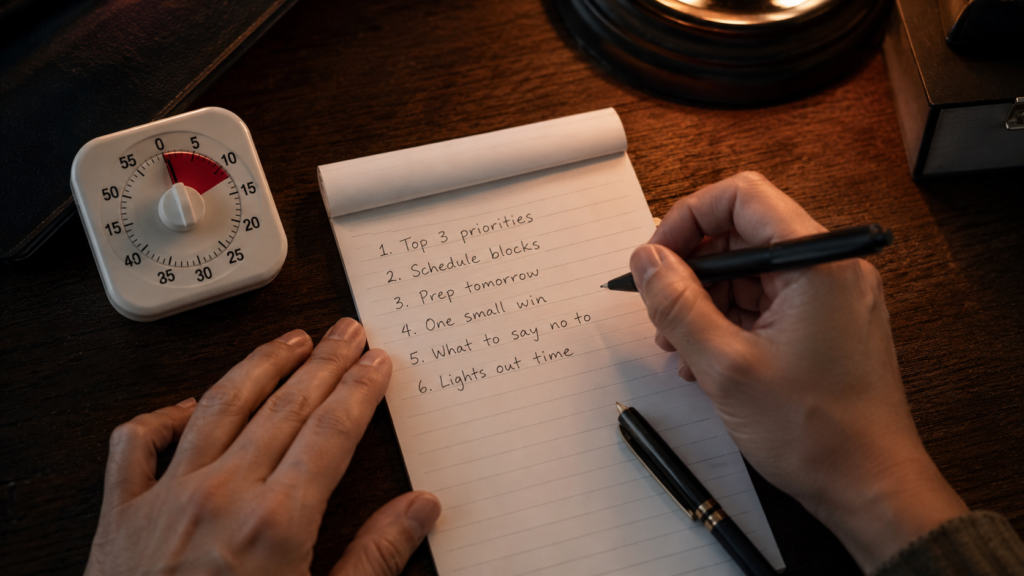
Here’s the actual sequence, timed, in the order that works — do it at the end of your workday rather than at bedtime, because your work context is still loaded and you’re not competing with a wind-down routine.
Dump everything open — 2 minutes
Every unfinished thing, in any order, no editing. Emails you owe, the thing your manager mentioned, the dentist. This isn’t the plan; it’s clearing the counter so you can see the plan. Set a timer, because two minutes is genuinely enough and five turns into brooding.
Pick the one — 1 minute
One item from the dump that, if it were the only thing you finished, would still make tomorrow count. Circle it. Not three candidates. One. If two feel equally urgent, ask which one someone is waiting on — that’s your tiebreaker.
Add two supports — 1 minute
Two more that genuinely have to happen. Three total. Everything else on the dump moves to a “maybe” column that you’re allowed to ignore without guilt — that permission is the point, and it’s what stops the list from becoming a debt sheet.
Attach a when and a where — 3 minutes
This is the step people skip, and it’s the one carrying most of the weight. Write each task as a trigger and a response: “If it’s 9 a.m. and I’m at my desk, I open the proposal doc and write the pricing section.” Not “work on proposal.” The format matters — more on why below.
Name the first physical action — 1 minute
What your hands literally do in the first sixty seconds. “Open Figma, duplicate the v3 frame.” Starting friction is almost always a decision problem dressed up as a motivation problem, and this line removes the decision.
Stage one object — 2 minutes
Put the physical thing where you’ll trip over it. Gym bag by the door, the printed brief on the keyboard, the notebook open to tomorrow’s page. Environment beats intention on the mornings when you’re tired, and tired mornings are the ones this habit exists for.
Step four deserves a proper explanation, because the wording genuinely changes the outcome. Psychologist Peter Gollwitzer calls these “implementation intentions” — if-then plans that link a situational cue to a specific behavior. In a meta-analysis with Paschal Sheeran covering 94 independent tests, if-then plans produced a medium-to-large effect on goal attainment (d = .65 overall, and d = .77 specifically on stopping people from getting derailed mid-effort). For context, holding a goal without a plan translates into action only around half the time.


The precision is doing the work, not the sentiment. One study cited in that literature had two groups pick the exact same self-chosen time to do the exact same task each week. One group wrote “I will do the task at ___.” The other wrote “If it is Wednesday at ___, then I will do the task.” Same time, same task, different sentence structure — and the if-then group hit their chosen time far more closely. You can read Gollwitzer and Sheeran’s own summary of the research if you want the primary source.
💡 TIP
If a task can’t be given a cue, it isn’t ready to be a task. “Sort out the website” has no trigger because it isn’t one action. Break it until a cue fits naturally — that’s your test for whether something belongs on tomorrow’s list at all.
The 3 + 2 Rule: How Many Things Actually Belong on Tomorrow’s List
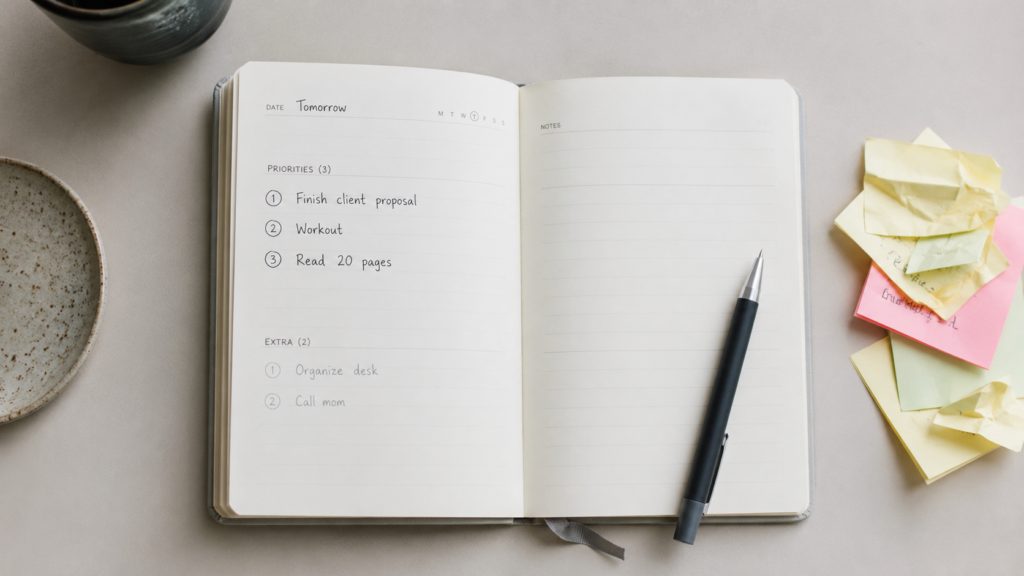
Overloading tomorrow is the most common way this habit dies in week two. You write eleven items, finish four, and conclude that planning doesn’t work for you — when the real problem is that you planned for a day that has never once existed.

Use three anchored commitments and two opportunistic wins. The three get cues and times. The two are the “if I get a clear stretch” items — no cue, no guilt, no carrying them forward as failures. Then run one sanity check before you close the notebook: count the hours tomorrow that are genuinely uncommitted. Not your working hours. The gaps between meetings, school runs, and shifts. If you have three uncommitted hours, plan three hours of work, not eight.
d = .65
Effect of if-then plans on goal attainment across 94 tests
~53%
Of good intentions that actually become behaviour without a plan
9 min
Faster sleep onset for bedtime to-do writers vs. done-list writers
What goes in the three slots depends on the shape of tomorrow, and this is where most templates fall down — they assume every day is a blank knowledge-work day. Here’s a decision rule you can apply in about twenty seconds:
✨ QUICK WIN
Tonight, write only the “one” — a single task with a time and a first physical action. Skip the other five steps entirely. Getting one repetition on the board tomorrow morning matters more than a complete system you abandon by Thursday. If you want the mechanics of starting absurdly small, the two-minute rule breaks it down further.
From the GetMoreGuide Library
A Planner Built Around the Night-Before Habit
If the blank-page problem is what stops you, a structured page helps more than willpower does. Our productivity planners give you the exact fields this article describes — the one, the two supports, the cue column, and the first physical action.
How to Plan Your Day the Night Before When Your Schedule Isn’t Fully Yours

Nearly every article on this topic quietly assumes you’re a desk worker with a calendar you control. Plenty of people aren’t. Nurses, parents of small kids, on-call engineers, retail supervisors, freelancers whose day is hijacked by whoever emails first — clock times are useless when tomorrow’s shape is genuinely unknown until it happens.
The fix is to anchor to events instead of hours. Gollwitzer’s research is explicit that the trigger in an if-then plan can be an external cue — a place, an object, a person, a moment — not just a time. So you swap “2 p.m.” for “the moment I sit down after the school run.” Cues like that survive a chaotic day because they’re tied to something that will happen regardless of how the day goes.
| Your situation | Weak anchor | Anchor that survives |
|---|---|---|
| Rotating shifts | “At 7 a.m.” | “After I hang up my coat at home” |
| Parent of young kids | “During nap” | “The second the kettle goes on after drop-off” |
| Reactive inbox job | “Before lunch” | “Before I open email for the first time” |
| On-call / interrupt-driven | “When things calm down” | “Every time I close a ticket, one line of the report” |
| Studying around a job | “In the evening” | “As soon as my bag hits the table” |
One more adjustment for unpredictable days: write a designated fallback. A single line at the bottom that reads “if the day gets eaten, the minimum is ___.” Fill it with something small enough that a genuinely terrible day still clears it — ten minutes on the priority, one email sent, one page read. That line is what keeps a bad Tuesday from becoming a collapsed week, and it pairs well with the way self-discipline actually gets built through smaller promises you keep.
Paper, App, or Calendar: Pick the Surface You’ll Actually Open at 6 a.m.
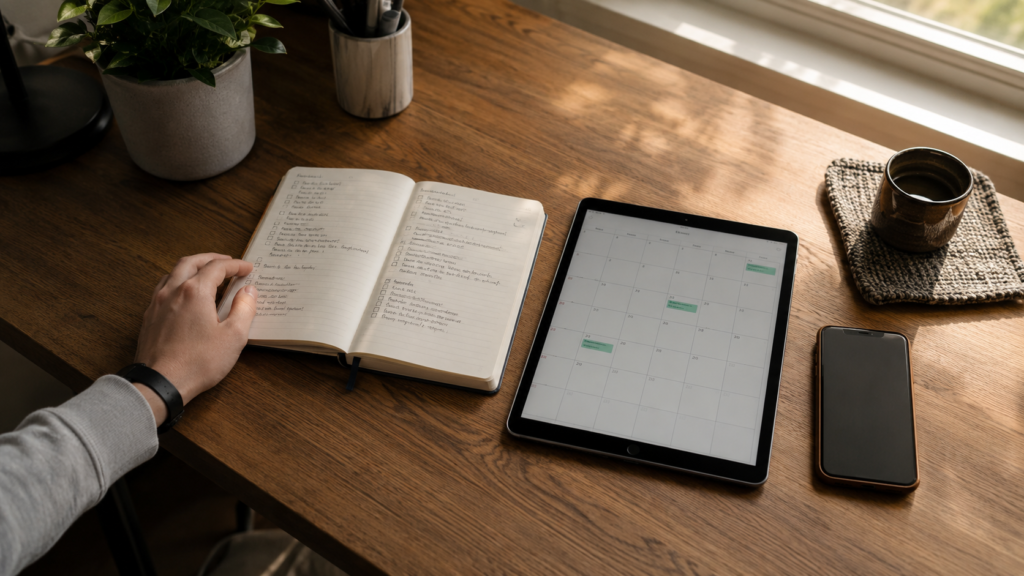
The tool matters less than people think, but it isn’t irrelevant — and the deciding factor isn’t features. It’s whether you’ll look at it before you look at anything else. A plan on your phone loses a fight with your phone roughly every morning.
My honest recommendation after years of watching people try all four: write the plan by hand, then put the three anchored items into your calendar with real start times. Hand-writing does the thinking; the calendar does the reminding. If you want the calendar half done properly, the complete guide to time blocking covers block sizing and buffers in detail. And if you’d rather run the whole thing analogue, a minimal bullet journal setup handles this in about four lines a day.
The 90-Second Morning Handoff That Keeps the Plan Alive

A night plan dies the moment morning-you decides to “just review it quickly.” Reviewing turns into re-deciding, re-deciding turns into a new plan, and you’ve spent your best hour doing the job you already did last night. The handoff has to be short and non-negotiable.
- Read, don’t rewrite. Look at the page once. No editing before the first block ends. If something genuinely changed overnight — a cancelled meeting, an urgent request — adjust after you’ve done the first thing, not before.
- Start at the first physical action, not the task. You wrote “open Figma, duplicate the v3 frame” for a reason. Do that literal thing. Momentum is a starting problem, not a willpower problem.
- Delay input for the length of the first block. No email, no messages, no news until the first anchored task is done or its block has run out. This is the single change most people report as the difference-maker.
- Mark the page, don’t recopy it. A line through a finished item, a dot next to a moved one. Recopying is procrastination wearing a productivity costume.
“
The plan isn’t there to make tomorrow perfect. It’s there so that tomorrow starts without an argument.
And when the plan breaks — it will, probably twice a week — the recovery move is not to rebuild the day. It’s to look at your fallback line and do that instead. A day where you did the minimum on purpose is a completely different psychological event from a day where you did nothing and felt bad about it. If chronic avoidance is the real pattern underneath, the deeper fix is in this system for people who’ve already tried everything to stop procrastinating.
Five Night-Before Planning Mistakes That Quietly Wreck the Habit
1. Listing your options instead of choosing one
“I could work on the deck in the morning, or after lunch, or maybe Thursday” feels like planning. It isn’t. In one of the Masicampo and Baumeister experiments, people who reflected on several possible ways to complete a task still had the same intrusive thoughts as people who made no plan at all. Only committing to one specific course of action cleared them. Do this instead: pick one version, write it, and delete the alternatives from the page so you can’t re-litigate at 7 a.m.
2. Judging the habit by whether it makes you feel calmer
This one surprises people. In two follow-up studies, making a plan didn’t reduce participants’ anxiety about their unfinished tasks at all — planners reported the same anxiety as non-planners, even while the intrusive thoughts and performance interference disappeared. The benefit is cognitive, not emotional. Do this instead: measure the habit by whether tomorrow starts faster, not by how you feel while writing the list.
3. Writing verbs with no object attached
“Follow up.” “Review.” “Sort out taxes.” Every one of these still contains an unmade decision, which is why they sit on lists for weeks. The Baylor sleep researchers found the same thing from the other direction — more specific task wording meant faster sleep onset. Do this instead: every line gets a verb, an object, and a destination. “Send Dana the Q3 revenue sheet” is a task. “Follow up with Dana” is a worry.
4. Planning tomorrow before you’ve closed today
If today’s loose ends are still floating, they’ll contaminate tomorrow’s list — you’ll write half-finished things as fresh tasks and inflate the day. Do this instead: take sixty seconds first to note where today’s unfinished work actually stands (“proposal: pricing done, intro not started”). You’re writing a handover note to yourself, and it stops tomorrow-you re-reading the whole document to figure out where you were.
5. Doing it in bed, on your phone
The Baylor participants wrote by hand, in a controlled environment, with technology removed — that’s the condition the nine-minute result came from. Planning on a phone in bed puts you one tap from every notification you own, and the list competes with an infinite feed. Do this instead: plan at your desk before you leave it, or at the kitchen table with the phone in another room. If bedtime is genuinely your only window, use paper.
Questions People Ask Before They Commit to This Habit
Go Deeper
The Focus Engine
A night-before plan only pays off if you can hold attention long enough to execute it. This guide covers the attention side: protecting the first block, rebuilding focus after interruptions, and designing an environment that doesn’t fight you at 9 a.m.
Get the Ebook →Every other habit in this space asks you to become a more disciplined person. This one just asks you to move a decision ten hours earlier, to a moment when it’s cheap. Learning how to plan your day the night before won’t make tomorrow go the way you drew it — but it will make sure tomorrow starts, and starting is where most days are won or lost.
📝 KEEP READING
Build the surrounding system: set goals you’ll actually finish, then build a morning routine that outlasts January. If your blocker is how you interpret a bad day, start with growth mindset versus fixed mindset.
More systems like this in the Productivity section.
Editorial note: This article is general educational content on planning and work habits. Research findings are cited from published, peer-reviewed sources and describe group averages, not guaranteed individual outcomes. Nothing here is medical or sleep-disorder advice — if you regularly struggle to fall asleep, speak with a qualified healthcare professional.